Biceps Tendinopathy
Front-of-shoulder pain with pulling, lifting, and overhead reach.
What it is
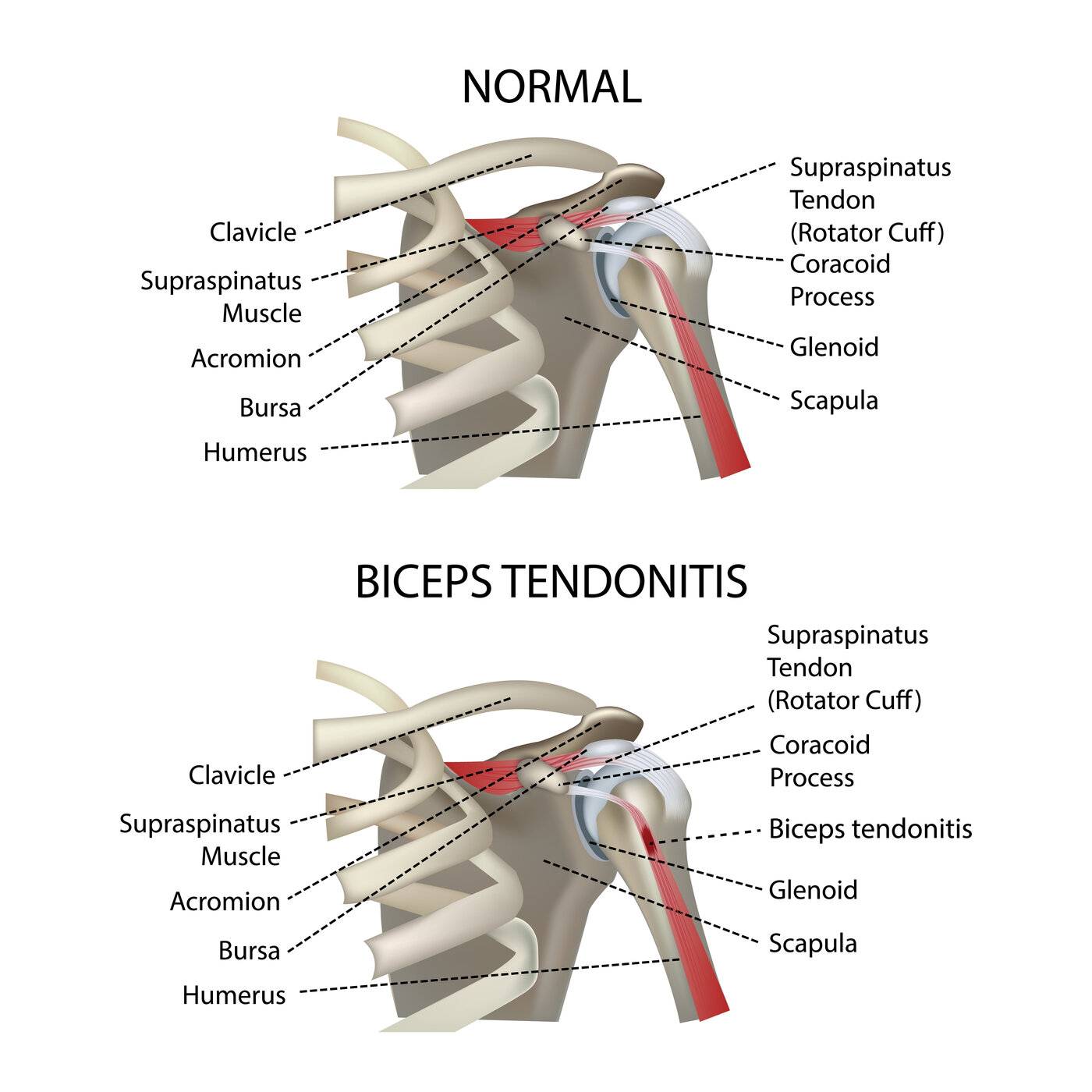
Irritation of the long head of the biceps tendon, often alongside rotator cuff issues.
Common symptoms
- Front-shoulder pain
- Pain with biceps curls or pulls
- Tender in the bicipital groove
Why it happens: root cause
Shoulder control and capacity vs. pulling/overhead load. When load on a tissue chronically exceeds its capacity, pain shows up. My job is to close that gap, by lowering load, raising capacity, or both, so the tissue stops being overwhelmed.
A closer look
Irritation of the long head of the biceps tendon at the front of the shoulder, felt with pulling, lifting, and overhead reach. It rarely travels alone, and often alongside rotator cuff or labral issues, so I assess the whole shoulder.
What causes it(Load > Capacity = Pain)
- Shoulder control and capacity vs pulling/overhead load
- Volume spikes
- Cuff and scapular contribution
- Sometimes labral involvement
Why it keeps coming back
- Shoulder control and capacity not restored
- Returning to pulling/overhead too soon
- Unaddressed cuff issues
Why rest, stretching, and passive care aren't enough
Rest calms it but doesn't build capacity, progressive loading plus addressing the cuff and scapula is the fix.
Conditions that can mimic this
- Rotator cuff tendinopathy
- Shoulder impingement
- SLAP / labral irritation
- AC joint pain
Clarius MSK can image the biceps tendon in the groove and assess the nearby cuff.
How I treat it
How the ADAPT Method treats your Biceps Tendinopathy
- A
Assess
Identify whether the long head of biceps is the primary driver vs. cuff or labral involvement. Clarius MSK ultrasound is used when it sharpens the diagnosis.
- D
Decrease Pain
Modify overhead and pulling volume, then layer Focused Shockwave (ESWT), Radial Pressure Wave (EPAT), and EMTT on the biceps tendon and anterior shoulder to calm the irritated tissue, laser therapy (photobiomodulation) can help with reactive pain.
- A
Activate
Restore thoracic mobility, scapular control, and cuff balance so the biceps isn't compensating.
- P
Progress
Progressive loading of the biceps and cuff together, and isometrics into heavy-slow curls, rows, and pulldown variants.
- T
Transfer
Return to lifting, pulling, or sport with a maintenance plan.
ADAPT closes the gap between LOAD and CAPACITY, lowering what's stressing the tissue while building what the tissue can handle.
FAQ
Is biceps tendinopathy serious?+
Usually no, it's an overload of the long head of biceps and often coexists with cuff irritation. Both get addressed together.
Should I stop curls and pulls?+
Modify, not stop. I change angle and load, often switching to neutral-grip or supported variants, so the tendon keeps training.
Does shockwave help?+
Yes, it's a well-supported tool for upper-extremity tendinopathies, paired with loading.
Do I need an MRI?+
Usually no, at least not first. Most musculoskeletal issues are diagnosed by history and exam. I use Clarius MSK diagnostic ultrasound in-office when it actually changes the plan: confirming a tendon issue, ruling between two diagnoses, or guiding treatment. I refer for MRI when red flags or surgical questions warrant it.
What if my biceps tendon ruptures?+
Long-head biceps rupture (the 'Popeye' deformity) usually does fine functionally without surgery in non-throwing athletes. I assess case by case.
How long until it feels better?+
Most cases improve meaningfully in 6 to 10 weeks of focused care.
Do you take insurance?+
Form & Function is a cash-based (self-pay) practice; I don't bill insurance directly. That lets me spend more time with you and build your plan around what you actually need, not what an insurer will approve. Fees are discussed up front. On request I can provide a detailed receipt (superbill) you may submit to your insurance for possible out-of-network reimbursement, though reimbursement isn't guaranteed.
What happens at the first visit?+
I sit down and talk through your history, training, and what you've already tried. Then I go through a hands-on movement and strength assessment, look at the painful area (and the joints above and below), and use Clarius MSK ultrasound in-office when it sharpens the diagnosis. You leave with a working diagnosis and a written plan, not a vague 'come back next week.'
Book your evaluation.
An honest assessment is the first step in the ADAPT method, and the fastest path to a real plan.