
Rotator Cuff Pain & Tendinopathy
Shoulder pain with overhead reach, lying on the shoulder, or pressing.
What it is
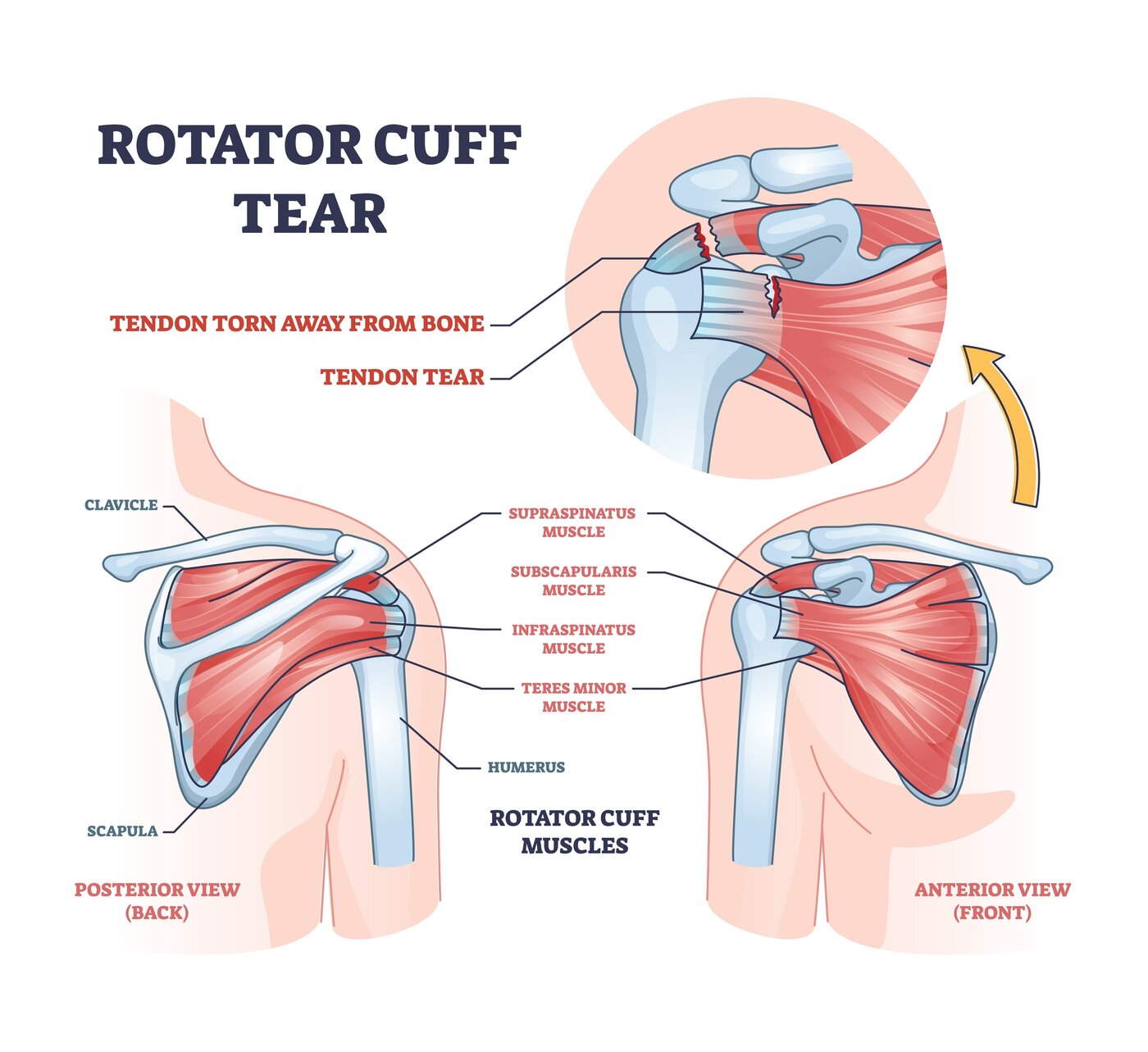
Tendinopathy or partial tearing of the rotator cuff tendons. Extremely common, and very treatable without rushing to surgery.
Common symptoms
- Pain with overhead reach
- Night pain lying on the shoulder
- Weakness in external rotation or pressing
Why it happens: root cause
Cuff and scapular control vs. the demands you put on the shoulder. When load on a tissue chronically exceeds its capacity, pain shows up. My job is to close that gap, by lowering load, raising capacity, or both, so the tissue stops being overwhelmed.
A closer look
Rotator cuff pain is usually tendinopathy or partial tearing of the cuff tendons; very common and very treatable without rushing to surgery. Even many tears do well with loading; imaging findings don't dictate the plan on their own.
What causes it(Load > Capacity = Pain)
- Cuff and scapular control deficits relative to demand
- Overhead and pressing volume spikes
- Thoracic stiffness and posture
- Age-related tendon changes
- Prior injury
Why it keeps coming back
- Cuff and scapular strength not restored
- Returning to overhead load too soon
- Thoracic mobility left unaddressed
Why rest, stretching, and passive care aren't enough
Conditions that can mimic this
Clarius MSK ultrasound can image the cuff tendons dynamically and help gauge a tear when it matters.
How I treat it
How the ADAPT Method treats your Rotator Cuff Pain & Tendinopathy
- A
Assess
Differentiate cuff tendinopathy, partial tear, and impingement-driven irritation. Clarius MSK ultrasound is used to look at the cuff directly when it changes the plan.
- D
Decrease Pain
Modify overhead and pressing volume, then layer Focused Shockwave (ESWT), Radial Pressure Wave (EPAT), and EMTT on the rotator cuff and surrounding shoulder tissue to calm inflammation and kick-start tendon remodeling. Laser therapy (photobiomodulation) can be added for reactive flares.
- A
Activate
Restore thoracic mobility and scapular control so the cuff isn't the only muscle group on the job.
- P
Progress
Progressive cuff and scapular loading, isometrics first, then heavy-slow rotation and pressing, dosed to symptoms.
- T
Transfer
Return to overhead lifting, throwing, or daily life with a small, repeatable cuff-strength routine you keep doing.
ADAPT closes the gap between LOAD and CAPACITY, lowering what's stressing the tissue while building what the tissue can handle.
FAQ
Do I need surgery for a rotator cuff tear?+
Most partial-thickness and many full-thickness cuff tears do well with conservative care. Surgery is for failed conservative care or specific full-thickness tears in younger patients. Imaging findings alone don't decide it.
Should I rest the shoulder?+
No. Cuff tendons get worse with prolonged rest. I modify load, not eliminate it.
Do I need an MRI?+
Usually no, at least not first. Most musculoskeletal issues are diagnosed by history and exam. I use Clarius MSK diagnostic ultrasound in-office when it actually changes the plan: confirming a tendon issue, ruling between two diagnoses, or guiding treatment. I refer for MRI when red flags or surgical questions warrant it.
Does shockwave or EMTT help the cuff?+
Yes, both have evidence for chronic cuff tendinopathy, and I often pair them. The strength program is what drives the long-term win.
What about a cortisone shot?+
Useful occasionally to break a severe pain cycle so you can rehab. Repeated cortisone in the subacromial space weakens the cuff and is associated with worse outcomes long-term.
How long does it take to feel better?+
Most cuff issues feel meaningfully better in 6 to 10 weeks; tendinopathy remodels over several months.
Will it come back?+
Only if cuff strength fades. Two short sessions a week is usually enough to hold the gains.
Do you take insurance?+
Form & Function is a cash-based (self-pay) practice; I don't bill insurance directly. That lets me spend more time with you and build your plan around what you actually need, not what an insurer will approve. Fees are discussed up front. On request I can provide a detailed receipt (superbill) you may submit to your insurance for possible out-of-network reimbursement, though reimbursement isn't guaranteed.
What happens at the first visit?+
I sit down and talk through your history, training, and what you've already tried. Then I go through a hands-on movement and strength assessment, look at the painful area (and the joints above and below), and use Clarius MSK ultrasound in-office when it sharpens the diagnosis. You leave with a working diagnosis and a written plan, not a vague 'come back next week.'
Book your evaluation.
An honest assessment is the first step in the ADAPT method, and the fastest path to a real plan.