Patellar Tendinopathy (Jumper's Knee)
Pain at the bottom of the kneecap, worse with jumping, squatting, and downhill running.
What it is
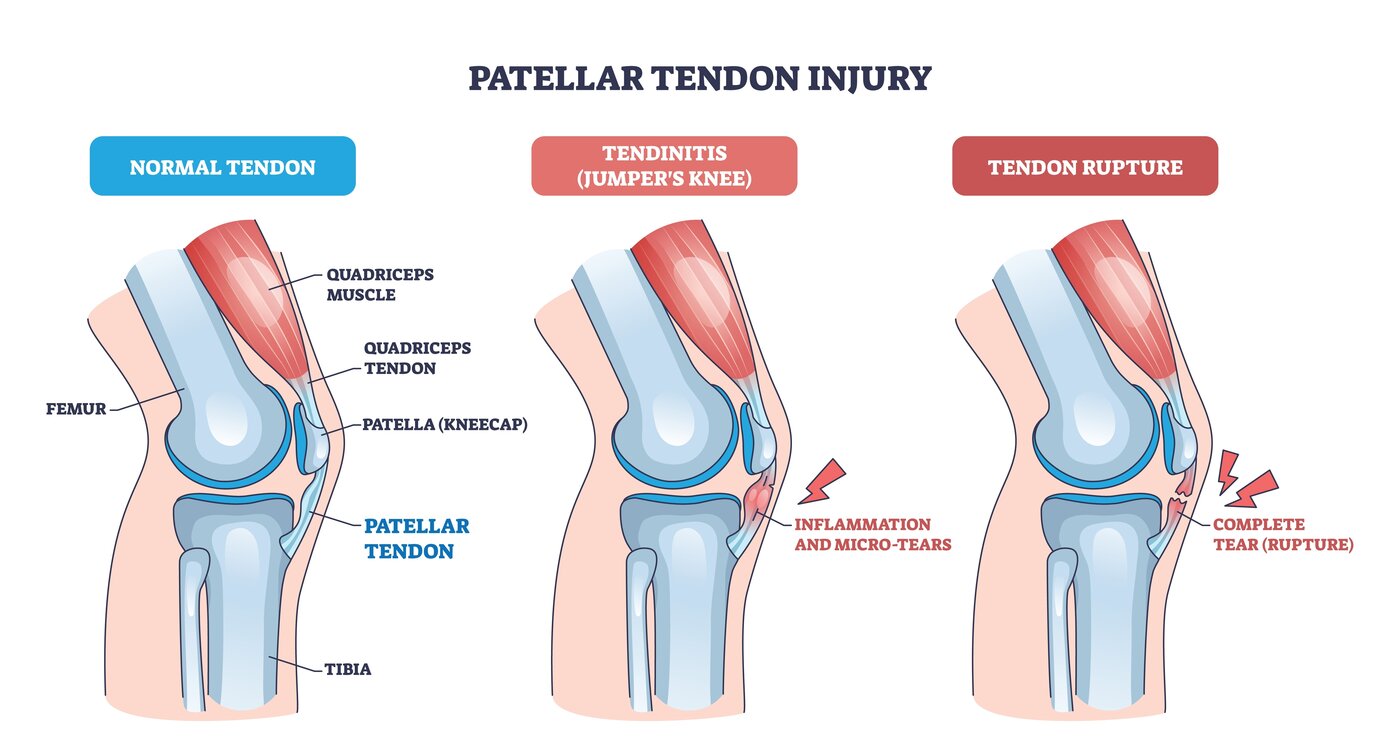
Degeneration of the patellar tendon from repetitive loading that has outpaced its capacity to adapt.
Common symptoms
- Pinpoint pain just below the kneecap
- Worse with jumps, deep squats, downhill
- Stiff first thing in the morning
Why it happens: root cause
Tendon capacity hasn't kept up with explosive or eccentric loading. When load on a tissue chronically exceeds its capacity, pain shows up. My job is to close that gap, by lowering load, raising capacity, or both, so the tissue stops being overwhelmed.
A closer look
Pain at the patellar tendon just below the kneecap, known as jumper's knee. A true tendon-loading problem driven by repetitive energy-storage demands (jumping, deep squatting, downhill running) outpacing the tendon's capacity. Distinct from patellofemoral pain, which is a joint and load-distribution issue.
What causes it(Load > Capacity = Pain)
- Spikes in jumping, plyometric, or downhill volume
- Deep-squat or heavy eccentric loading
- Quad and calf capacity deficits
- Rapid training progression
- Stiff ankles increasing tendon demand
Why it keeps coming back
- The tendon feels better before it's actually stronger
- Skipping the progressive loading phase
- Returning to explosive work too soon
Why rest, stretching, and passive care aren't enough
Rest and stretching settle symptoms but don't build tendon capacity; progressive loading (often heavy-slow and energy-storage work) is the foundation of recovery.
Conditions that can mimic this
- Patellofemoral pain
- Fat pad (Hoffa's) irritation
- Quadriceps tendinopathy
- Osgood-Schlatter (younger athletes)
Clarius MSK ultrasound can confirm tendon involvement and gauge severity when needed.
How I treat it
How the ADAPT Method treats your Patellar Tendinopathy (Jumper's Knee)
- A
Assess
Exam confirms patellar tendon (vs. fat pad or patellofemoral), and I screen jumping/squatting capacity. Clarius MSK ultrasound is used to confirm tendon changes when it sharpens the diagnosis.
- D
Decrease Pain
Modify jumping, deep squatting, and downhill running short-term, then layer Focused Shockwave (ESWT), Radial Pressure Wave (EPAT), and EMTT on the patellar tendon and surrounding area to drive tendon remodeling, laser therapy (photobiomodulation) can settle reactive flares.
- A
Activate
Restore ankle dorsiflexion, hip and quad control, and posterior-chain length so the tendon isn't shouldering everything.
- P
Progress
Heavy-slow resistance loading (Spanish squats, leg press, decline squats) progressed by symptom response; this is the proven driver of tendon adaptation.
- T
Transfer
Graded return to jumping, cutting, and downhill running with a tendon-monitoring routine you can run yourself.
ADAPT closes the gap between LOAD and CAPACITY, lowering what's stressing the tissue while building what the tissue can handle.
FAQ
What causes patellar tendinopathy?+
Jumping, cutting, and heavy quad loading outpaced the tendon's ability to adapt. Common in basketball, volleyball, lifters, and runners who do a lot of hills or downhills.
Should I stop training?+
Almost never fully. Tendons need load to remodel. I modify the spicy stuff (deep jumps, max squats) while loading the tendon in a tolerable range.
How long does it take to heal?+
Expect real change in 8 to 12 weeks of heavy-slow loading, with continued remodeling for months. Patellar tendinopathy is a slow win, but it does win.
Does shockwave work for jumper's knee?+
Yes. Focused Shockwave plus a loading program is one of the better-supported combinations in tendinopathy care. EMTT layered in helps the deeper tissue environment.
Do I need an MRI?+
Usually no, at least not first. Most musculoskeletal issues are diagnosed by history and exam. I use Clarius MSK diagnostic ultrasound in-office when it actually changes the plan: confirming a tendon issue, ruling between two diagnoses, or guiding treatment. I refer for MRI when red flags or surgical questions warrant it.
Is a cortisone shot a good idea?+
Generally no. Cortisone in or near a load-bearing tendon weakens it and is associated with worse long-term outcomes and rupture risk. I don't recommend it for this.
Should I stretch the quad?+
Static quad stretching can compress the tendon and flare it. I choose mobility carefully here, decompression and isometrics often calm it better.
Will it come back?+
Only if heavy-slow loading drops out of your routine. Two sessions a week, year-round, is usually enough to keep the tendon ahead of your sport.
Do you take insurance?+
Form & Function is a cash-based (self-pay) practice; I don't bill insurance directly. That lets me spend more time with you and build your plan around what you actually need, not what an insurer will approve. Fees are discussed up front. On request I can provide a detailed receipt (superbill) you may submit to your insurance for possible out-of-network reimbursement, though reimbursement isn't guaranteed.
What happens at the first visit?+
I sit down and talk through your history, training, and what you've already tried. Then I go through a hands-on movement and strength assessment, look at the painful area (and the joints above and below), and use Clarius MSK ultrasound in-office when it sharpens the diagnosis. You leave with a working diagnosis and a written plan, not a vague 'come back next week.'
Book your evaluation.
An honest assessment is the first step in the ADAPT method, and the fastest path to a real plan.