
Knee Osteoarthritis
Stiff, achy knees, common after injury, surgery, or decades of sport.
What it is
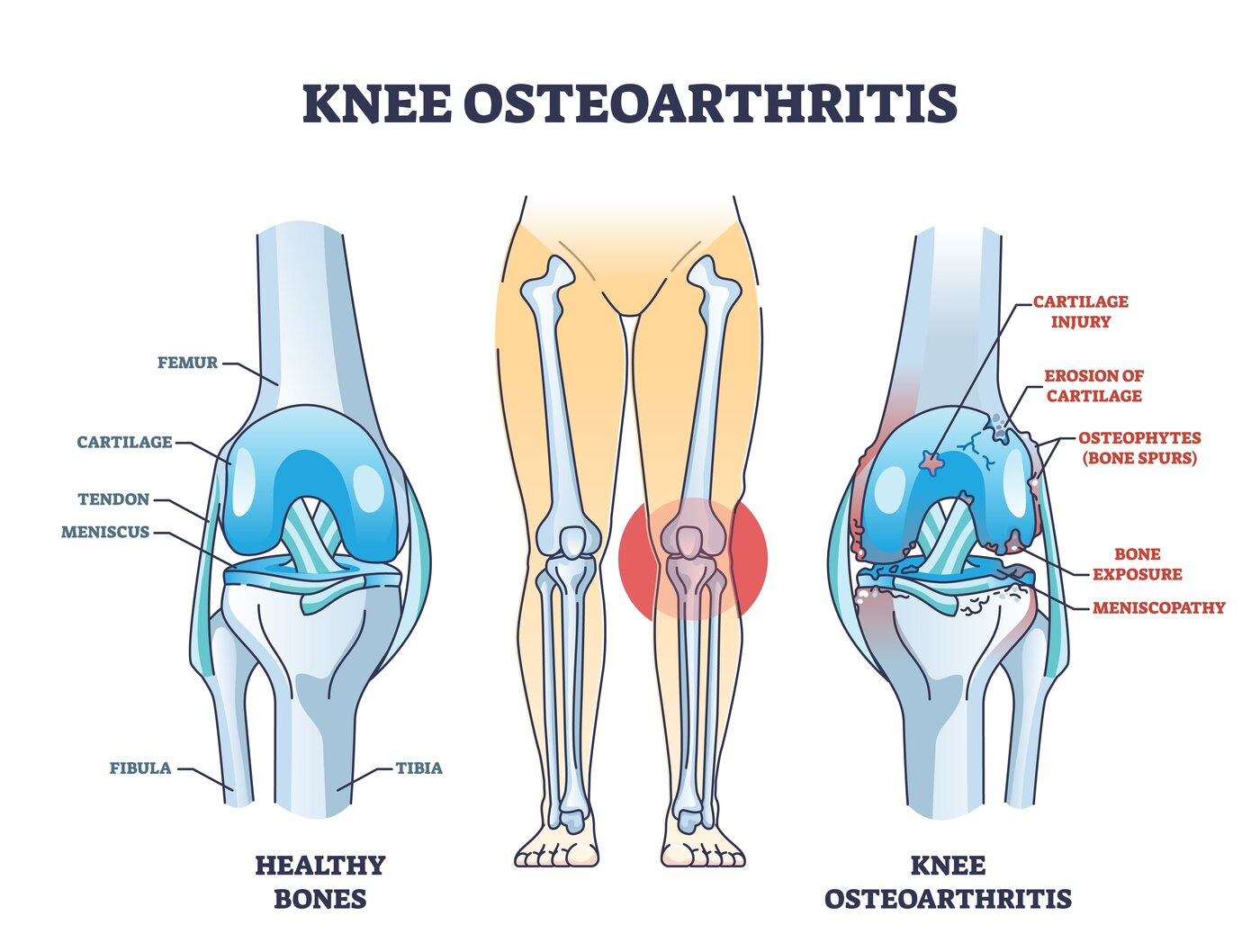
Cartilage and joint changes that reduce shock absorption and tolerance for load. Movement and strength are still the foundation of management.
Common symptoms
- Morning stiffness that eases with movement
- Achy after long days or activity
- Reduced range, occasional swelling
Why it happens: root cause
Loss of joint capacity and surrounding muscle strength relative to daily demands. When load on a tissue chronically exceeds its capacity, pain shows up. My job is to close that gap, by lowering load, raising capacity, or both, so the tissue stops being overwhelmed.
A closer look
Cartilage and joint changes that reduce shock absorption and load tolerance. Movement and strength, not rest, are the foundation of management. The goal is to raise what the joint can handle, not to avoid using it.
What causes it(Load > Capacity = Pain)
- Loss of surrounding muscle strength relative to daily demands
- Prior injury or surgery
- Decades of sport or impact
- Load spikes after inactivity
- Body-composition and metabolic factors
Why it keeps coming back
- Doing too much too soon after a quiet spell
- Deconditioning between flares
- Avoiding the joint entirely, which lowers capacity further
Why rest, stretching, and passive care aren't enough
Rest and avoidance lower capacity and make flares more likely. Progressive loading, strength, and regenerative therapy (EMTT and laser) improve tolerance, a 2025 RCT supports EMTT for knee osteoarthritis.
Conditions that can mimic this
- Patellofemoral pain
- Meniscus injury
- Patellar tendinopathy
- Referred hip pain
Imaging severity often doesn't match symptoms, and I treat the person and the function, not just the X-ray.
How I treat it
How the ADAPT Method treats your Knee Osteoarthritis
- A
Assess
Functional exam (range, single-leg control, gait), training history, and any prior imaging. I treat the person in front of me, not the X-ray.
- D
Decrease Pain
Modify aggravating loads and volume short-term, then use Focused Shockwave (ESWT), Radial Pressure Wave (EPAT), and EMTT around the knee joint to settle inflammation and support cartilage health, and paired with chiropractic mobility work to restore range.
- A
Activate
Restore knee, hip, and ankle mobility and reactivate quad and glute strength that's faded.
- P
Progress
Progressive strength loading, leg press, split squats, step-ups, dosed to the joint, plus aerobic conditioning the knee tolerates.
- T
Transfer
Return-to-activity plan (walking, hiking, lifting, sport) with a maintenance program so the knee keeps gaining capacity year over year.
ADAPT closes the gap between LOAD and CAPACITY, lowering what's stressing the tissue while building what the tissue can handle.
FAQ
Does an osteoarthritic knee mean I need surgery?+
Not by default. Most knees with OA do extremely well with strength, mobility, and load management. Surgery is for knees that have failed a real conservative program and have function-limiting symptoms.
Should I stop running or exercising?+
No. The strongest data I have says movement and strength help OA; rest and atrophy make it worse. I modify, I don't shut down.
Will cortisone shots help long-term?+
Short-term pain relief, yes, but repeat cortisone in the knee is associated with faster cartilage loss. I treat it as an occasional tool, not a strategy.
Does EMTT or laser actually help arthritis?+
Yes. EMTT has randomized-controlled-trial evidence in knee OA, and laser therapy (photobiomodulation) helps with pain modulation. I pair them with the strength work that drives long-term capacity.
Do I need an MRI?+
Usually no, at least not first. Most musculoskeletal issues are diagnosed by history and exam. I use Clarius MSK diagnostic ultrasound in-office when it actually changes the plan: confirming a tendon issue, ruling between two diagnoses, or guiding treatment. I refer for MRI when red flags or surgical questions warrant it.
I was told I'm 'bone on bone.' Is exercise dangerous?+
No. The 'bone on bone' label is descriptive, not prescriptive. Plenty of people with that imaging walk, lift, and hike comfortably when their muscle capacity supports the joint.
How long until it feels better?+
Most people feel meaningful improvement in 6 to 10 weeks; the bigger gains compound over months as strength returns.
Do you take insurance?+
Form & Function is a cash-based (self-pay) practice; I don't bill insurance directly. That lets me spend more time with you and build your plan around what you actually need, not what an insurer will approve. Fees are discussed up front. On request I can provide a detailed receipt (superbill) you may submit to your insurance for possible out-of-network reimbursement, though reimbursement isn't guaranteed.
What happens at the first visit?+
I sit down and talk through your history, training, and what you've already tried. Then I go through a hands-on movement and strength assessment, look at the painful area (and the joints above and below), and use Clarius MSK ultrasound in-office when it sharpens the diagnosis. You leave with a working diagnosis and a written plan, not a vague 'come back next week.'
Book your evaluation.
An honest assessment is the first step in the ADAPT method, and the fastest path to a real plan.