
Why 'wait until it stops hurting' keeps failing runners with Achilles pain, and what the research actually says to do instead.
If your Achilles keeps flaring every time you build back up, you do not have a rest problem, you have a capacity problem. Rest quiets the pain but leaves the tendon weak, so it breaks down again on the first hard run. The fix is smart, progressive loading, supported when needed by shockwave and EMTT, and a return to running judged by function, not by pain.
If you run, you know how this goes. The back of your heel starts barking. It is stiff for the first mile, loosens up, then screams the next morning. And you get told the same thing every time. Rest it. Stop running. Let it calm down.
So you rest. The pain fades. You lace up again, and within two runs it is right back where it started.
Here is what usually goes unsaid. Your Achilles pain and what your Achilles can actually handle are two different things. Rest quiets the pain. It does almost nothing for the capacity. That gap is why you keep landing back at square one.
A study out of the University of Delaware tendon lab put real numbers on this, and it should change how you think about coming back from Achilles tendinopathy.
What the researchers did
They took 20 runners with Achilles tendinopathy and compared the sore leg to the healthy leg on four things.
- Pain, tested during running and jumping
- Structure, measured with ultrasound for tendon thickness and cross sectional area
- Stiffness, meaning the actual material quality of the tendon
- Function, through a battery of jump and hop tests
Then they estimated how much force was actually running through the Achilles while these runners ran, and looked at what that force lined up with.
What they found
- The sore leg hurt more during running and jumping. No surprise there.
- The sore tendon was thicker with more cross sectional area, the classic angry, remodeled look on ultrasound.
- The sore tendon was less stiff. The material itself had degraded and lost quality.
- The sore leg had lower jump height and worse hopping.
- The finding that matters most: the force running through the Achilles during a comfortable run was about the same on both legs.
That last one deserves a second look. The injured tendon was not being overloaded on the run. The load was normal. What had changed was the tendon's ability to store and return that load. Its stiffness and its spring were gone.
One more result worth knowing for timing your return. How high a runner could do a drop countermovement jump lined up with the force their tendon handled while running. A simple jump test reflected what the tendon was doing at speed.
Why pain and imaging both mislead you
This is the whole point. The two things runners lean on most to judge a tendon, how much it hurts and how it looks on ultrasound, did not tell the real story.
Pain faded with rest while the tendon stayed weak and flat. Imaging stayed thick and ugly long after the tendon was ready to work again. The thing that actually told the truth was function. Could the leg jump, hop, and load like the other side.
So when you rest until the pain is gone and then run, you are trusting the one signal that misleads you. The pain is quiet, but the spring never came back. First hard run, the tendon cannot return the load, and you are hurt again.
A tendon is a spring. You do not fix a broken spring by putting it in a drawer. You fix it by loading it, carefully and progressively, until the spring comes back.
How to rebuild it
Here is the loading progression I use with runners. It is built from the research on heavy slow resistance and progressive tendon loading, the standard of care behind the study above. Think of it as the general roadmap, not a replacement for an assessment of your tendon.
One rule governs all of it. Load to a pain level of 5 out of 10 or less, and it should settle back to your normal by the next morning. Pain during the work is fine. Pain that is worse the next day means you did too much.
| Phase | Exercise | Sets and reps | Tempo or load | Frequency | Goal |
|---|---|---|---|---|---|
| 1. Calm and activate (weeks 1 to 2) | Isometric heel raise hold, double then single leg | 5 x 45 sec | Hold mid range, pain 3 out of 10 or less | 1 to 2x per day | Settle pain, switch the tendon on |
| 2. Build the base (weeks 2 to 5) | Double leg heel raise, standing | 3 x 15 | 3 sec up, 3 sec down | Daily | Baseline capacity |
| 2. Build the base (weeks 2 to 5) | Seated bent knee heel raise | 3 x 15 | 3 sec up, 3 sec down | Daily | Target the soleus |
| 2. Build the base (weeks 2 to 5) | Progress to single leg heel raise | 3 x 15 | 3 sec up, 3 sec down | Daily | Restore symmetry |
| 3. Heavy slow resistance (weeks 4 to 12) | Standing calf raise, loaded | 3 to 4 sets | 3 sec up, 3 sec down. Load from about 15RM to 6RM over the weeks | 3x per week | Rebuild stiffness and strength |
| 3. Heavy slow resistance (weeks 4 to 12) | Seated calf raise, loaded | 3 to 4 sets | 3 sec up, 3 sec down, add load | 3x per week | Soleus strength |
| 3. Heavy slow resistance (weeks 4 to 12) | Eccentric single leg drop from a step, knee straight and knee bent | 3 x 15 each | Slow lower, pain 5 out of 10 or less | up to 2x per day | Remodel the tendon |
| 4. Spring and return to run (week 10 and up) | Pogo hops, double then single leg | 3 x 20 to 30 sec | Stiff, springy, quiet feet | 3x per week | Reintroduce the stretch shorten cycle |
| 4. Spring and return to run (week 10 and up) | Drop countermovement jumps | 3 x 8 to 10 | Explosive up, controlled landing | 2 to 3x per week | Rebuild the spring, the study's readiness marker |
| 4. Spring and return to run (week 10 and up) | Bounding and A skips | 3 x 20 meters | Progressive | 2x per week | Bridge to running speed |
How to know you are ready to run
Not when it stops hurting. When these check out.
- Your single leg heel raise capacity on the sore side is within about 10 to 20 percent of the good side.
- Your jump and hop height on the sore leg gets close to the healthy leg, the study's own sign that the tendon can handle running level force.
- Running pain stays at 3 out of 10 or less and settles by the next morning.
And no, do not wait for the ultrasound to look normal. Thickening can stick around for months after the tendon is fully back to work.
Not sure where your Achilles, or your training, actually stands? Take my free ADAPT Running Assessment and get a personalized starting point in a few minutes.
Where the other tools fit
Loading is the foundation. Nothing here replaces it. These are what I reach for to calm a cranky tendon down, support the tissue while the strength catches up, and get stubborn cases moving again. They make the loading work. They are not a shortcut around it.
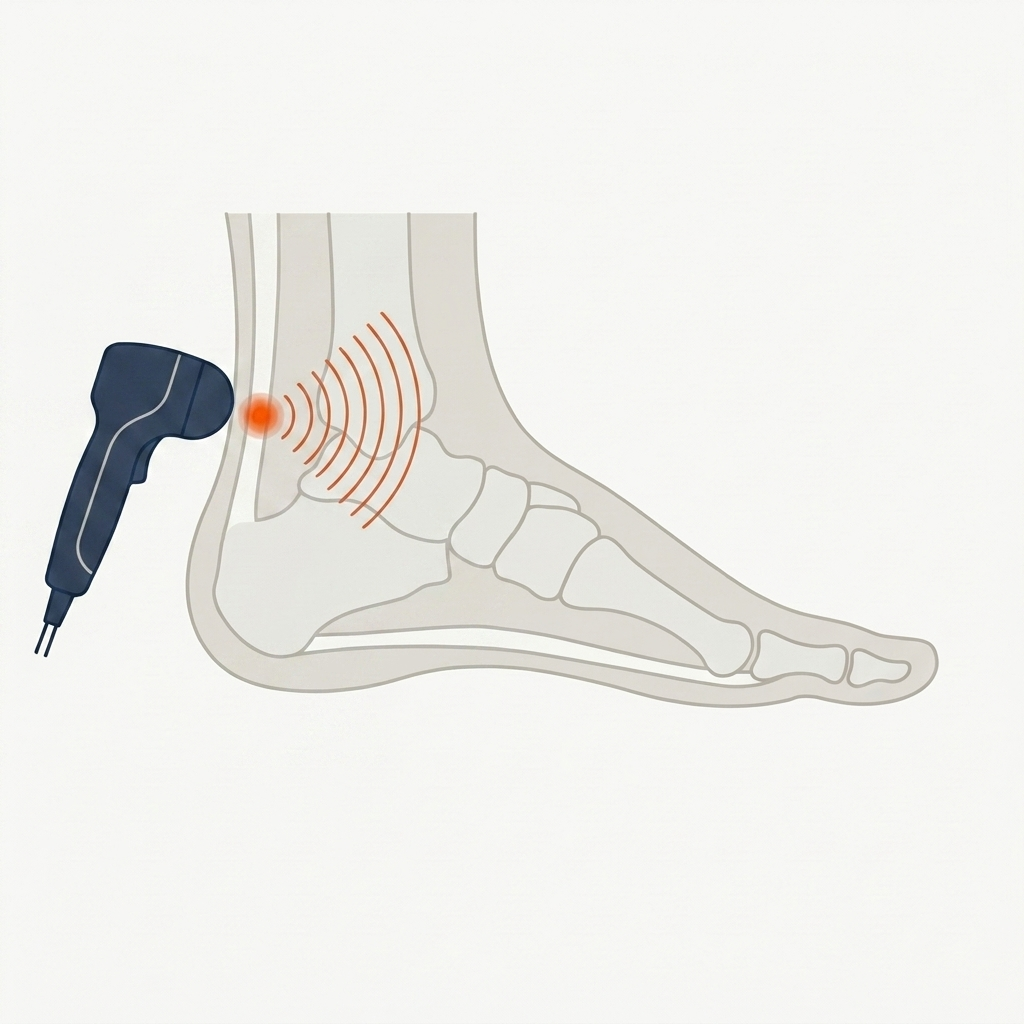
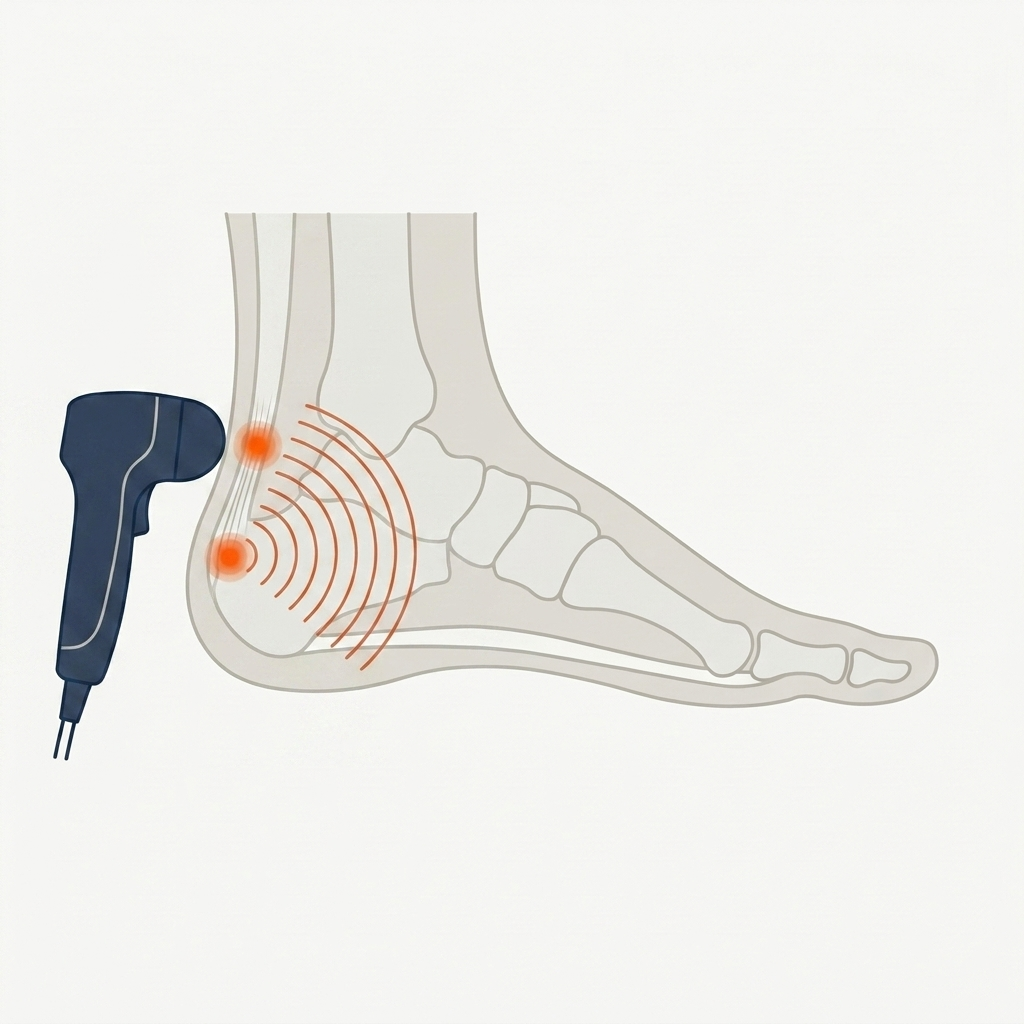
First, one distinction that changes the whole plan. Midportion Achilles pain, a few centimeters up from the heel, tends to respond well to loading and to shockwave. Insertional Achilles pain, right where the tendon attaches to the heel bone, is more finicky. It needs a modified loading progression that does not jam the tendon into the bone, and the regenerative tools are used more selectively. Getting the type right comes first.
/Functional Range Conditioning
There is real overlap here, and that is worth being honest about. The heavy slow resistance work above is progressive loading, which is the heart of it. What Functional Range Conditioning adds is the joint. Often the tendon keeps flaring because the ankle above it cannot get the range or the control it needs, so the calf and Achilles end up absorbing what the joint should. Controlled articular rotations, end range strength, and ankle mobility work make sure a stiff or poorly controlled ankle is not the hidden reason the tendon keeps overloading. Complementary, not a competing plan.
/Radial pressure wave
Broader, more superficial acoustic waves. For midportion Achilles this has some of the strongest evidence in the whole toolbox. In a randomized trial, runners doing eccentric loading alone recovered or improved substantially about 56 percent of the time, while those who added radial pressure wave to the same loading hit about 82 percent. The shockwave did not replace the loading. It made the loading work better. A typical course is a few weekly sessions.
/Focused shockwave
Deeper, pinpointed energy. I use focused shockwave when the degenerated tissue sits deeper or right at the bone, and for stubborn cases that have stalled. For midportion Achilles the evidence for shockwave added to a loading program is moderate and fairly consistent. For insertional Achilles it is more mixed and the research is weaker, so I use it more selectively there, alongside loading that avoids compressing the tendon against the heel. The honest version. A strong add on for midportion, case by case for insertional.
/EMTT
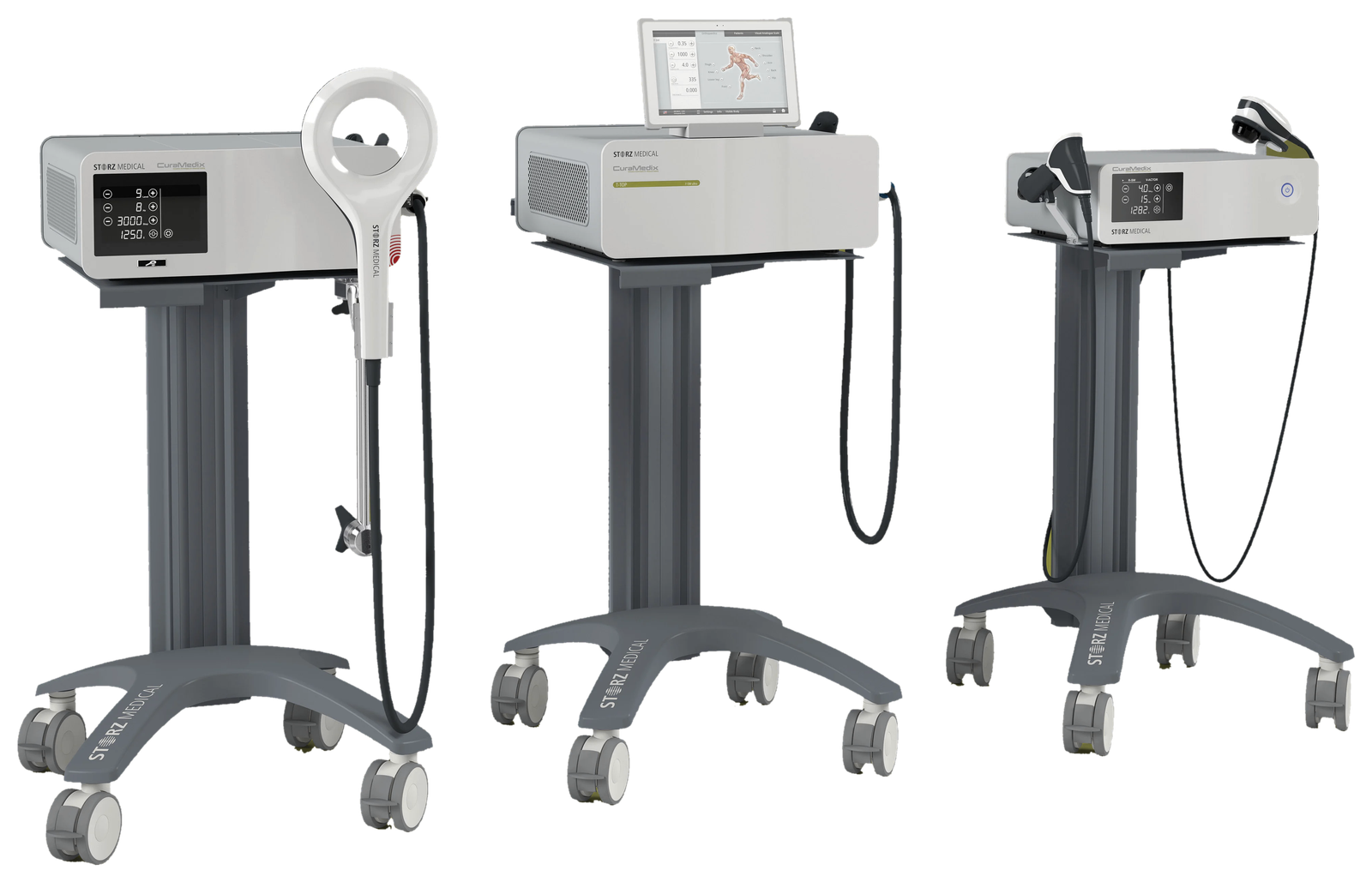
EMTT uses high energy magnetic pulses that work at the cellular level and reach deep tissue the acoustic waves can miss. It works well on a cranky Achilles, and I use it on myself. I generally combine it with radial pressure wave and focused shockwave rather than running it on its own, so the tendon gets worked at the surface, deep in the structure, and at the cell in the same visit. The sessions are quick, usually once or twice a week over a few weeks.
Across all of these, expect a course of roughly three to six weekly sessions, improvement building over several weeks, and the tendon continuing to remodel for months after. None of them are a shortcut around the loading. The loading is the foundation. These tools are what quiet the tendon down and let the loading finish the job.
The takeaway
If your Achilles flares every time you build back up, you do not have a rest problem. You have a capacity problem. The tendon lost its strength and its spring, and the only thing that rebuilds those is smart, progressive load. Not another two weeks off.
That is why I do not start with stop running. I assess the whole runner. How the tendon loads, how you jump and hop, how you actually move. Find why it keeps breaking down, and build it back so it holds. Keep you running, and make you better at it.
If you have been stuck in the rest, flare, rest loop with your Achilles, that is the loop we break. Book a whole runner assessment.
By Dr. Craig Patane, D.C. Sports chiropractor, certified running coach, and ultra and road runner. Founder of Form & Function Chiropractic and Rehab and the ADAPT method.
This article is educational and not a substitute for individual medical care. If you are dealing with Achilles pain, get assessed before starting a loading program.
Source: Corrigan P, Hornsby S, Pohlig RT, Willy RW, Cortes DH, Silbernagel KG. Tendon loading in runners with Achilles tendinopathy: relations to pain, structure, and function during return-to-sport. Scandinavian Journal of Medicine & Science in Sports, 2022;32(8):1201-1212.
Frequently Asked Questions
Should I rest my Achilles or keep loading it?
Rest calms the pain but does little for capacity, which is usually the real problem. Most Achilles tendinopathy responds best to smart, progressive loading rather than time off. Full rest tends to leave the tendon weak, so the pain returns on the first hard run.
How long does Achilles tendinopathy take to heal?
It varies, but a structured loading program generally runs about 8 to 12 weeks or more, moving from calming the tendon, to heavy slow resistance, to spring work and return to run. The tendon can keep remodeling for months after you are back to full training.
What is the difference between mid-portion and insertional Achilles tendinopathy?
Mid-portion pain sits a few centimeters above the heel, in the middle of the tendon, and tends to respond well to loading and shockwave. Insertional pain sits right where the tendon attaches to the heel bone and is more finicky, needing a modified loading approach that does not compress the tendon against the bone.
Does shockwave therapy work for Achilles tendinopathy?
For mid-portion Achilles, adding shockwave to a loading program has some of the strongest evidence in the toolbox, improving outcomes over loading alone. For insertional Achilles the evidence is more mixed, so it is used more selectively. Shockwave supports the loading, it does not replace it.
How do I know when I can run again?
Not when the pain stops. When your single leg heel raise and your jump and hop capacity on the sore side get close to the healthy side, and running pain stays low and settles by the next morning. Function is the real signal, not how the tendon looks on ultrasound.
More from Craig Patane on running and recovery
Continue on craigpatane.com
Related conditions & treatments
Not sure what you're dealing with?
A thorough evaluation tells me exactly where the load-capacity gap is and what it takes to close it.