Achilles Tendinopathy
Stiff, painful Achilles that warms up but flares after activity.
What it is
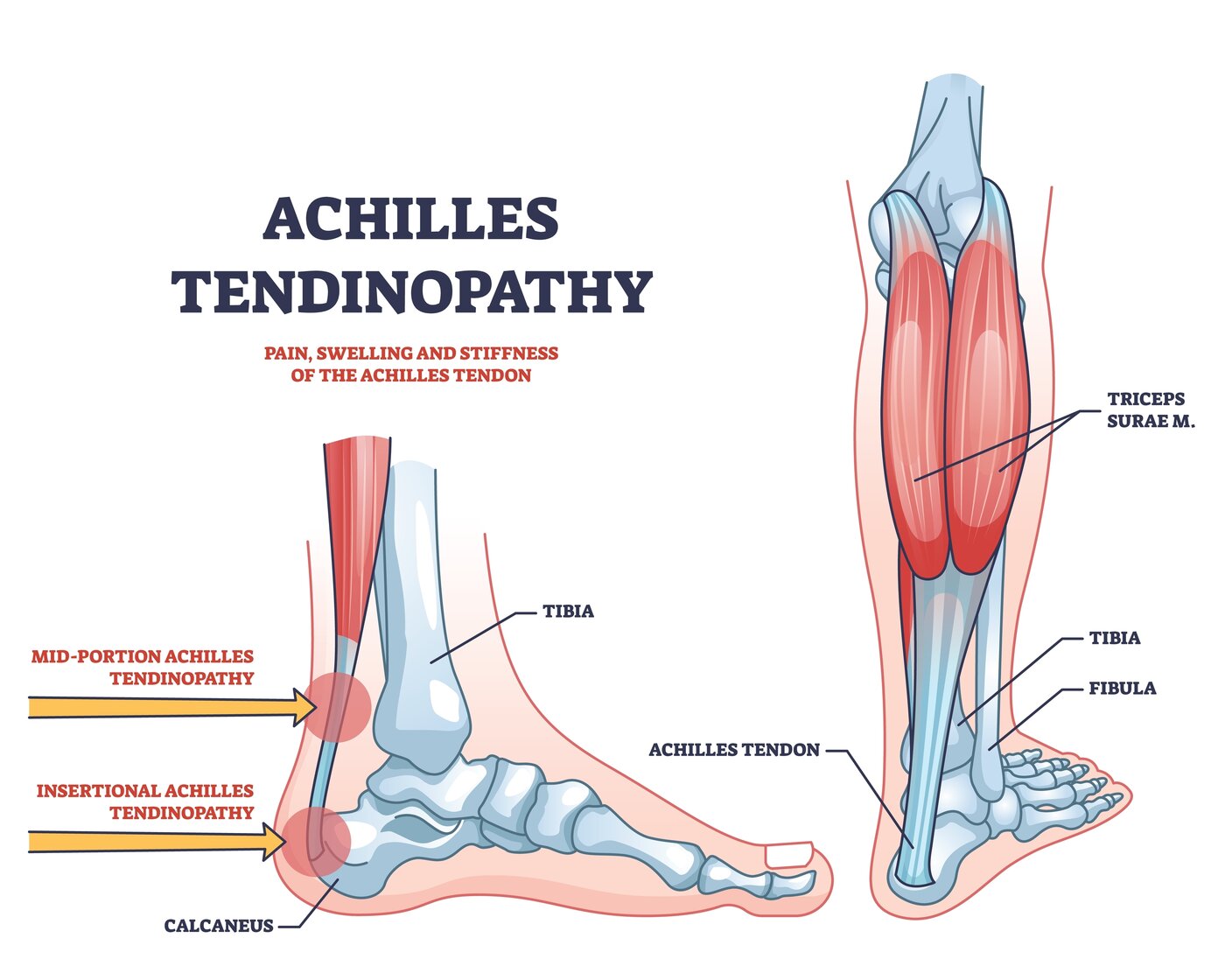
Degenerative changes in the Achilles tendon, either mid-portion or at its insertion on the heel, driven by overload faster than the tendon can adapt.
Common symptoms
- Morning stiffness in the Achilles
- Pain that warms up but returns after activity
- Thickening or a tender nodule
- Pain with calf raises or hills
Why it happens: root cause
Tendon capacity hasn't kept up with running volume, hills, or speed work. When load on a tissue chronically exceeds its capacity, pain shows up. My job is to close that gap, by lowering load, raising capacity, or both, so the tissue stops being overwhelmed.
A closer look
Insertional vs. mid-portion matters. Mid-portion Achilles tendinopathy occurs 2 to 6 cm above the heel, is more common in runners, and responds well to progressive loading. Insertional Achilles tendinopathy occurs where the tendon attaches to the heel, is more sensitive to compression, gets aggravated by uphill running and deep calf stretching, and needs modified loading, treating it like mid-portion can make it worse. Correct diagnosis matters, and Clarius MSK ultrasound can confirm location when needed.
What causes it(Load > Capacity = Pain)
- Sudden increases in running or training volume
- Tight or overloaded calf muscles
- Poor ankle mobility
- Inefficient running mechanics
- Inadequate strength or tendon capacity (the Achilles can see forces up to 10 to 12× body weight during running)
Why it keeps coming back
- The tendon feels better before it's actually stronger
- Returning to running too quickly
- Not restoring full calf strength
- Ignoring tendon load capacity
- Relying only on rest or passive care
Why rest, stretching, and passive care aren't enough
Rest, stretching, and passive care may reduce symptoms temporarily but don't restore tendon capacity. Progressive loading is the foundation of tendon recovery; everything else is supportive.
Conditions that can mimic this
- Calf muscle strain
- Retrocalcaneal bursitis
- Plantar fascia overload
- Posterior tibial tendon dysfunction
- Bone stress injury
- Nerve irritation
How I treat it
How the ADAPT Method treats your Achilles Tendinopathy
- A
Assess
Differentiate mid-portion vs. insertional Achilles, screen calf strength, ankle dorsiflexion, and your last 6 to 12 weeks of training. Clarius MSK ultrasound is used when I want to confirm tendon thickening or rule out a partial tear.
- D
Decrease Pain
Modify hills, speed work, and total volume, then layer Focused Shockwave (ESWT), Radial Pressure Wave (EPAT), and EMTT on the Achilles tendon and surrounding tissue to drive a healing response, laser therapy (photobiomodulation) helps calm reactive flares.
- A
Activate
Restore ankle dorsiflexion, calf mobility, and posterior-chain control with FRC-style work so the tendon isn't the only thing absorbing load.
- P
Progress
Progressive heavy-slow calf loading (the gold standard for tendinopathy): straight-knee, bent-knee, and eventually plyometrics, dosed to your tendon's reaction.
- T
Transfer
Structured return to running with cadence, hill, and speed progression mapped to weeks, plus a maintenance lift you keep doing.
ADAPT closes the gap between LOAD and CAPACITY, lowering what's stressing the tissue while building what the tissue can handle.
FAQ
What causes Achilles tendinopathy?+
The tendon was loaded faster than it could adapt. Common triggers: a mileage jump, new hills or speed work, switching shoe stack, or coming back from a layoff at your old pace. It's not 'inflammation', it's degeneration of the tendon's collagen structure.
Should I rest completely?+
No. Tendons get worse with prolonged rest. I modify load; not eliminate it, and use heavy-slow calf loading to drive remodeling. Most runners keep running through this rehab.
How long until it's actually better?+
Expect noticeable change in 6 to 12 weeks of disciplined loading, with continued remodeling over several months. Insertional cases (right at the heel) tend to be slower than mid-portion.
Can shockwave or EMTT help?+
Yes, and both have solid evidence for Achilles tendinopathy when added to a loading program. Shockwave delivers a focused mechanical signal to the tendon; EMTT works the deeper cellular environment. I often layer them.
Do I need an MRI?+
Usually no, at least not first. Most musculoskeletal issues are diagnosed by history and exam. I use Clarius MSK diagnostic ultrasound in-office when it actually changes the plan: confirming a tendon issue, ruling between two diagnoses, or guiding treatment. I refer for MRI when red flags or surgical questions warrant it.
What about stretching?+
Aggressive static stretching often makes insertional Achilles pain worse because it pinches the tendon against the heel. I'm picky about which mobility work you do.
Is surgery ever needed?+
Rarely, and only after a serious, well-dosed loading program (often 6+ months) has failed. The vast majority of Achilles tendinopathy responds to conservative care done correctly.
Will it come back?+
Only if you stop loading the calf once pain is gone. Tendon capacity is use-it-or-lose-it, I leave you with a 2-day-a-week minimum that protects it.
Do you take insurance?+
Form & Function is a cash-based (self-pay) practice; I don't bill insurance directly. That lets me spend more time with you and build your plan around what you actually need, not what an insurer will approve. Fees are discussed up front. On request I can provide a detailed receipt (superbill) you may submit to your insurance for possible out-of-network reimbursement, though reimbursement isn't guaranteed.
What happens at the first visit?+
I sit down and talk through your history, training, and what you've already tried. Then I go through a hands-on movement and strength assessment, look at the painful area (and the joints above and below), and use Clarius MSK ultrasound in-office when it sharpens the diagnosis. You leave with a working diagnosis and a written plan, not a vague 'come back next week.'
Book your evaluation.
An honest assessment is the first step in the ADAPT method, and the fastest path to a real plan.