Hamstring Strain & Tendinopathy
Pulled or persistently sore hamstring, often at the high attachment.
What it is
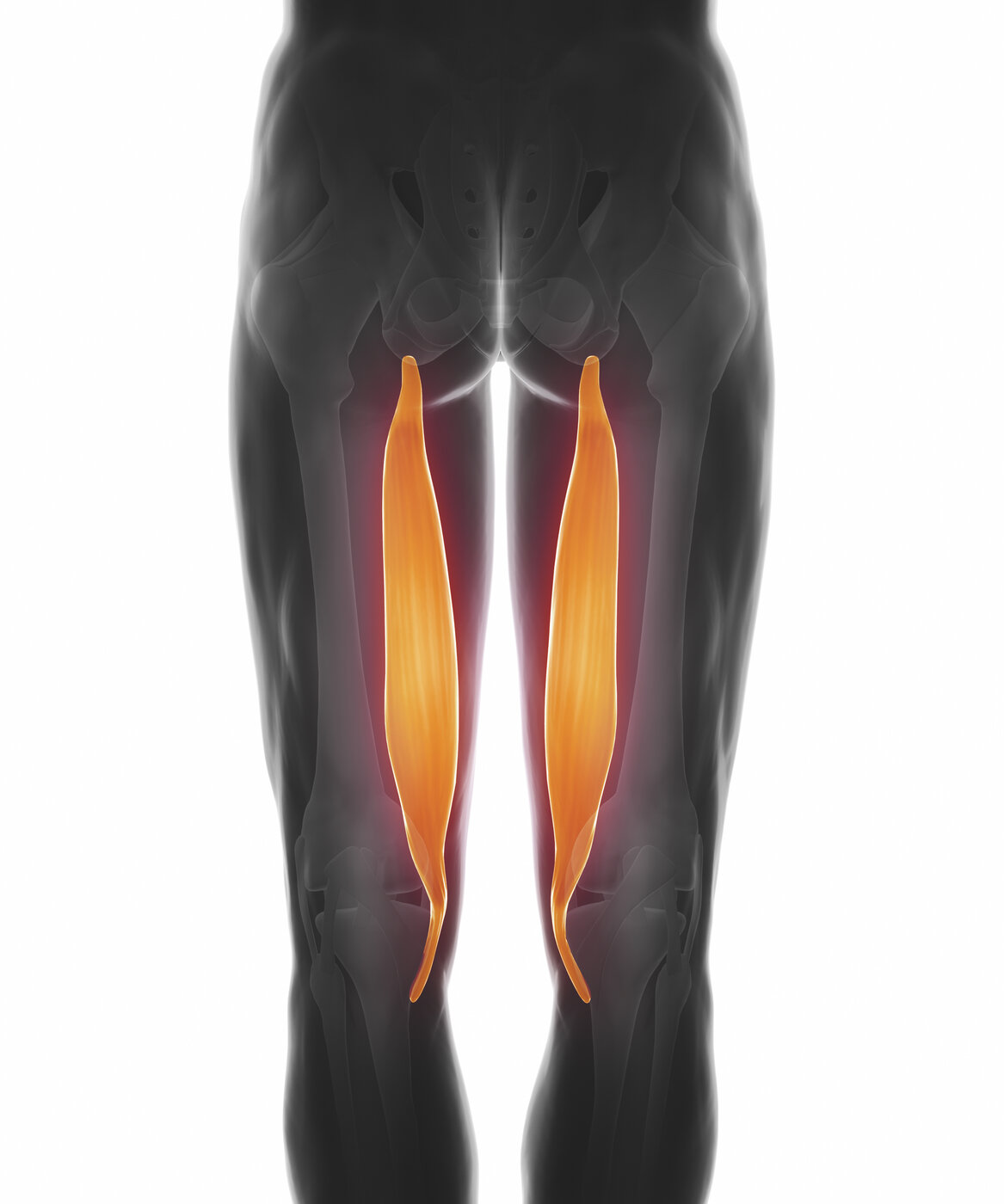
Acute strain or chronic tendinopathy of the hamstring complex, often near the sit-bone (proximal hamstring tendinopathy).
Common symptoms
- Sharp pain with sprinting or stretching
- Tender at the sit-bone with sitting
- Tightness that won't release
Why it happens: root cause
Hamstring capacity vs. sprint, stride, or sitting load. When load on a tissue chronically exceeds its capacity, pain shows up. My job is to close that gap, by lowering load, raising capacity, or both, so the tissue stops being overwhelmed.
A closer look
Two different problems with different rehab: an acute hamstring strain (a tear from sprinting or overstretch) versus chronic proximal hamstring tendinopathy (deep sit-bone pain that's worse with sitting and uphill running). Telling them apart matters.
What causes it(Load > Capacity = Pain)
- Hamstring capacity vs sprint, stride, and sitting load
- Rapid increases in speed work
- Compression at the sit-bone for proximal tendinopathy (sitting, deep hip flexion)
- Posterior-chain strength deficits
Why it keeps coming back
- Returning to sprinting before capacity is rebuilt (re-injury rates are high)
- Skipping eccentric and heavy loading
- Continued compression for proximal cases
Why rest, stretching, and passive care aren't enough
Rest and stretching, especially aggressive stretching for proximal tendinopathy, often prolong it. Progressive loading, including eccentric and high-speed work, is the foundation.
Conditions that can mimic this
Clarius MSK ultrasound can help confirm tendon vs muscle involvement and grade it.
How I treat it
How the ADAPT Method treats your Hamstring Strain & Tendinopathy
- A
Assess
Distinguish acute strain from chronic proximal hamstring tendinopathy (sit-bone tenderness, sitting pain). Clarius MSK ultrasound is used to confirm tendon involvement when needed.
- D
Decrease Pain
Modify sprinting, heavy hinging, and prolonged sitting short-term, then layer Focused Shockwave (ESWT), Radial Pressure Wave (EPAT), and EMTT on the hamstring tendon and muscle to drive remodeling, load it tolerably as symptoms settle.
- A
Activate
Restore hip mobility and posterior-chain length, and reactivate glute and hamstring co-contraction.
- P
Progress
Progressive hamstring loading, long-lever hinges, Nordics, and eccentric work dosed to the tendon's response.
- T
Transfer
Return-to-sprint and sport plan with speed exposure built in carefully, plus a year-round Nordic/hinge minimum that prevents recurrence.
ADAPT closes the gap between LOAD and CAPACITY, lowering what's stressing the tissue while building what the tissue can handle.
FAQ
How is a hamstring strain different from tendinopathy?+
A strain is acute; a clear pull during sprinting or stretching. Proximal hamstring tendinopathy is chronic, hurts at the sit-bone, and flares with sitting and uphill running. Treatment overlaps but the dosing is different.
Should I stretch a strained hamstring?+
Not aggressively. Static stretching of an angry tendon makes it worse. I use loading, not stretching, to drive healing.
Should I stop running?+
Usually I modify. Sprints and hills are the typical aggravators; easy mileage often stays in.
Does shockwave help?+
Yes, especially for chronic proximal hamstring tendinopathy, where Focused Shockwave plus heavy-slow loading is the combination with the best track record.
Do I need an MRI?+
Usually no, at least not first. Most musculoskeletal issues are diagnosed by history and exam. I use Clarius MSK diagnostic ultrasound in-office when it actually changes the plan: confirming a tendon issue, ruling between two diagnoses, or guiding treatment. I refer for MRI when red flags or surgical questions warrant it.
How long do hamstring injuries take?+
Acute strains: typically 3 to 8 weeks depending on grade. Chronic tendinopathy: expect 8 to 16 weeks of loading for real change.
Will it come back?+
Hamstring injuries have the highest re-injury rate in sport, but that risk drops sharply with a maintained Nordic/hinge program. I make that a habit, not a phase.
Do you take insurance?+
Form & Function is a cash-based (self-pay) practice; I don't bill insurance directly. That lets me spend more time with you and build your plan around what you actually need, not what an insurer will approve. Fees are discussed up front. On request I can provide a detailed receipt (superbill) you may submit to your insurance for possible out-of-network reimbursement, though reimbursement isn't guaranteed.
What happens at the first visit?+
I sit down and talk through your history, training, and what you've already tried. Then I go through a hands-on movement and strength assessment, look at the painful area (and the joints above and below), and use Clarius MSK ultrasound in-office when it sharpens the diagnosis. You leave with a working diagnosis and a written plan, not a vague 'come back next week.'
Book your evaluation.
An honest assessment is the first step in the ADAPT method, and the fastest path to a real plan.