Bone Stress Injury / Stress Fracture
Focal bone pain that worsens with impact and doesn't go away.
What it is
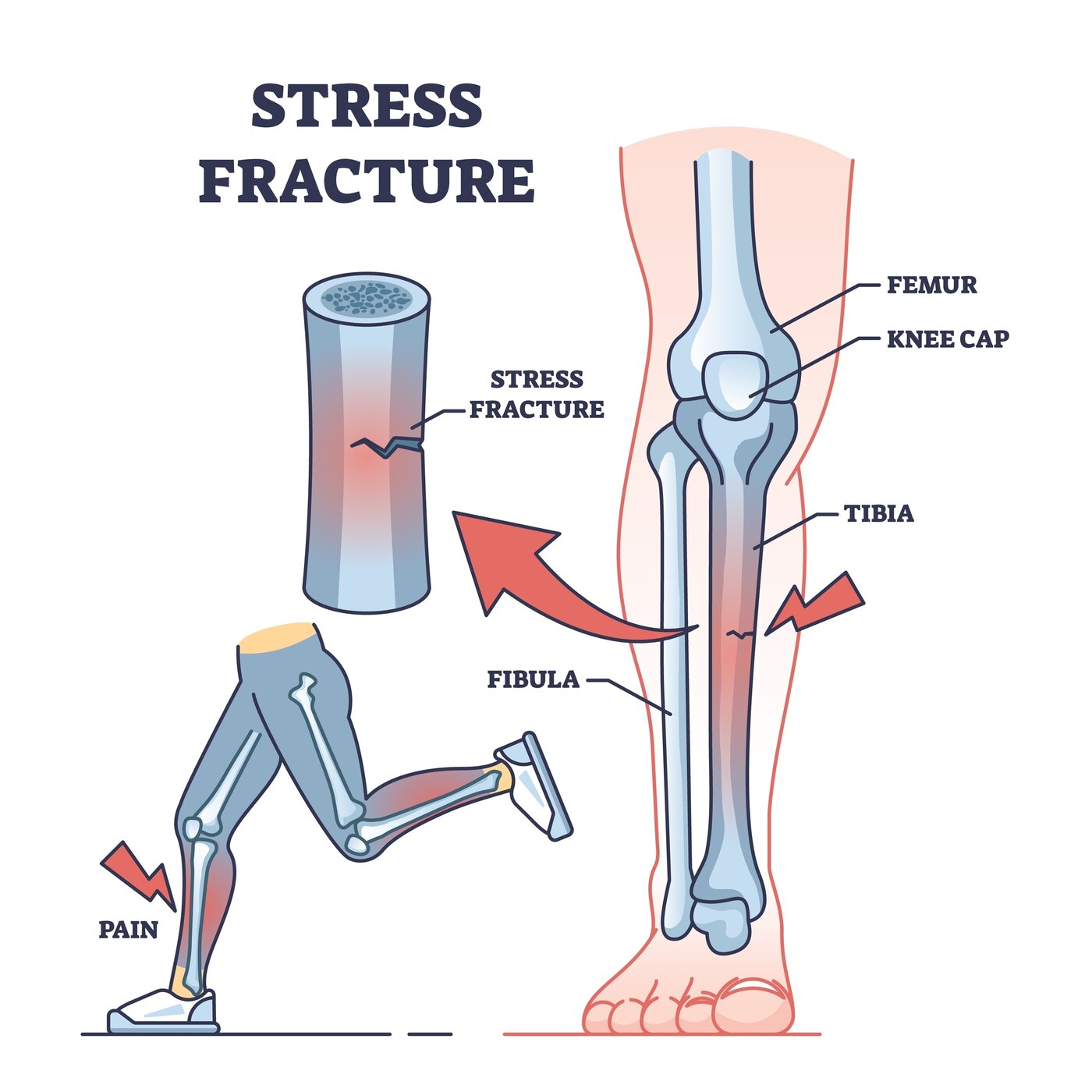
A bone's remodeling response has been outpaced by repetitive load, common in the tibia, metatarsals, navicular, and femur in runners.
Common symptoms
- Focal, pinpoint bone pain
- Pain with impact, hopping, or single-leg load
- Often progresses over weeks
Why it happens: root cause
Cumulative load > bone capacity, often with under-fueling, sleep debt, or rapid mileage increases. Imaging-confirmed cases need medical management, and I coordinate. When load on a tissue chronically exceeds its capacity, pain shows up. My job is to close that gap, by lowering load, raising capacity, or both, so the tissue stops being overwhelmed.
A closer look
Bone stress injuries exist on a spectrum from an early bone stress reaction to a structural fracture, developing when repetitive loading outpaces the bone's ability to remodel and recover. Early diagnosis matters, and without proper load management, a stress reaction can progress to a true fracture and prolong recovery.
What causes it(Load > Capacity = Pain)
- Rapid mileage increases
- Training intensity spikes
- Surface changes
- Strength deficits
- Biomechanical overload
- Nutritional and recovery factors (under-fueling, low energy availability, sleep debt)
Why it keeps coming back
- Training errors not corrected
- Strength deficits left unaddressed
- Biomechanical contributors ignored
- Returning to impact too soon
Why rest, stretching, and passive care aren't enough
Healing requires activity modification and medical guidance, protect the healing bone first, then progressively rebuild load tolerance. Low-impact cross-training (cycling, pool running, strength work) maintains fitness while the bone heals.
Conditions that can mimic this
- Shin splints (MTSS)
- Tendinopathy
- Chronic exertional compartment syndrome
- Nerve entrapment
Persistent focal or worsening pain may need MRI, early stress injuries often don't show on standard X-rays. Imaging-confirmed cases need medical co-management, which I coordinate.
How I treat it
How the ADAPT Method treats your Bone Stress Injury / Stress Fracture
- A
Assess
Clinical exam (hop test, focal palpation, tuning fork) plus a careful training, nutrition, sleep, and menstrual history. I coordinate imaging (MRI is the standard) and medical co-management when needed.
- D
Decrease Pain
Offload impact appropriately for the site and grade, then use Focused Shockwave (ESWT), Radial Pressure Wave (EPAT), and EMTT where indicated to support bone remodeling, and paired with metabolic and fueling work to close the load-capacity gap.
- A
Activate
Maintain aerobic fitness with non-impact cross-training and keep working hip, core, and upper-body strength while bone heals.
- P
Progress
Progressive return to impact in stages, walking, walk/jog, jog, run, gated by symptoms and timeline, not the calendar alone.
- T
Transfer
Structured return-to-run with mileage caps and a load-monitoring plan, plus Metabolic & Body Composition Testing if under-fueling was part of the cause.
ADAPT closes the gap between LOAD and CAPACITY, lowering what's stressing the tissue while building what the tissue can handle.
FAQ
What causes a stress fracture?+
Cumulative impact load outran the bone's ability to remodel. Big contributors: rapid mileage ramps, under-fueling (RED-S), low vitamin D, poor sleep, and; in some runners, menstrual irregularities. Bone is a slow-adapting tissue.
Do I need an MRI?+
If I clinically suspect a bone stress injury, yes. MRI is the gold standard for staging it. X-ray often misses early stress reactions. I coordinate the referral.
How long does a stress fracture take to heal?+
Most low-risk sites heal in 6 to 8 weeks of offloading; high-risk sites (femoral neck, navicular, anterior tibia) take longer and require careful management. Return-to-run is staged, not a single date.
Can I cross-train?+
Almost always, pool running, bike, elliptical, and upper-body work keep your fitness alive. I pick options that don't load the injured site.
Does shockwave help bone healing?+
There's good evidence for shockwave in delayed and non-union fracture healing, and it's used selectively for established stress fractures. I don't use it on every case, I choose based on the site and stage.
Will it come back?+
Recurrence drops sharply when I fix the root cause: fueling, sleep, mileage progression, and bone-loading habits (strength training is the most under-used tool here). Skipping that is how runners get a second one.
Should I get a bone density (DEXA) scan?+
If you've had more than one stress fracture, or have other risk factors (low BMI, RED-S history, hormonal changes), yes, I'll guide you on what to ask for.
Do you take insurance?+
Form & Function is a cash-based (self-pay) practice; I don't bill insurance directly. That lets me spend more time with you and build your plan around what you actually need, not what an insurer will approve. Fees are discussed up front. On request I can provide a detailed receipt (superbill) you may submit to your insurance for possible out-of-network reimbursement, though reimbursement isn't guaranteed.
What happens at the first visit?+
I sit down and talk through your history, training, and what you've already tried. Then I go through a hands-on movement and strength assessment, look at the painful area (and the joints above and below), and use Clarius MSK ultrasound in-office when it sharpens the diagnosis. You leave with a working diagnosis and a written plan, not a vague 'come back next week.'
Book your evaluation.
An honest assessment is the first step in the ADAPT method, and the fastest path to a real plan.