
Sciatica / Low Back Pain
Back pain with or without leg symptoms that interferes with sleep, work, and training.
What it is
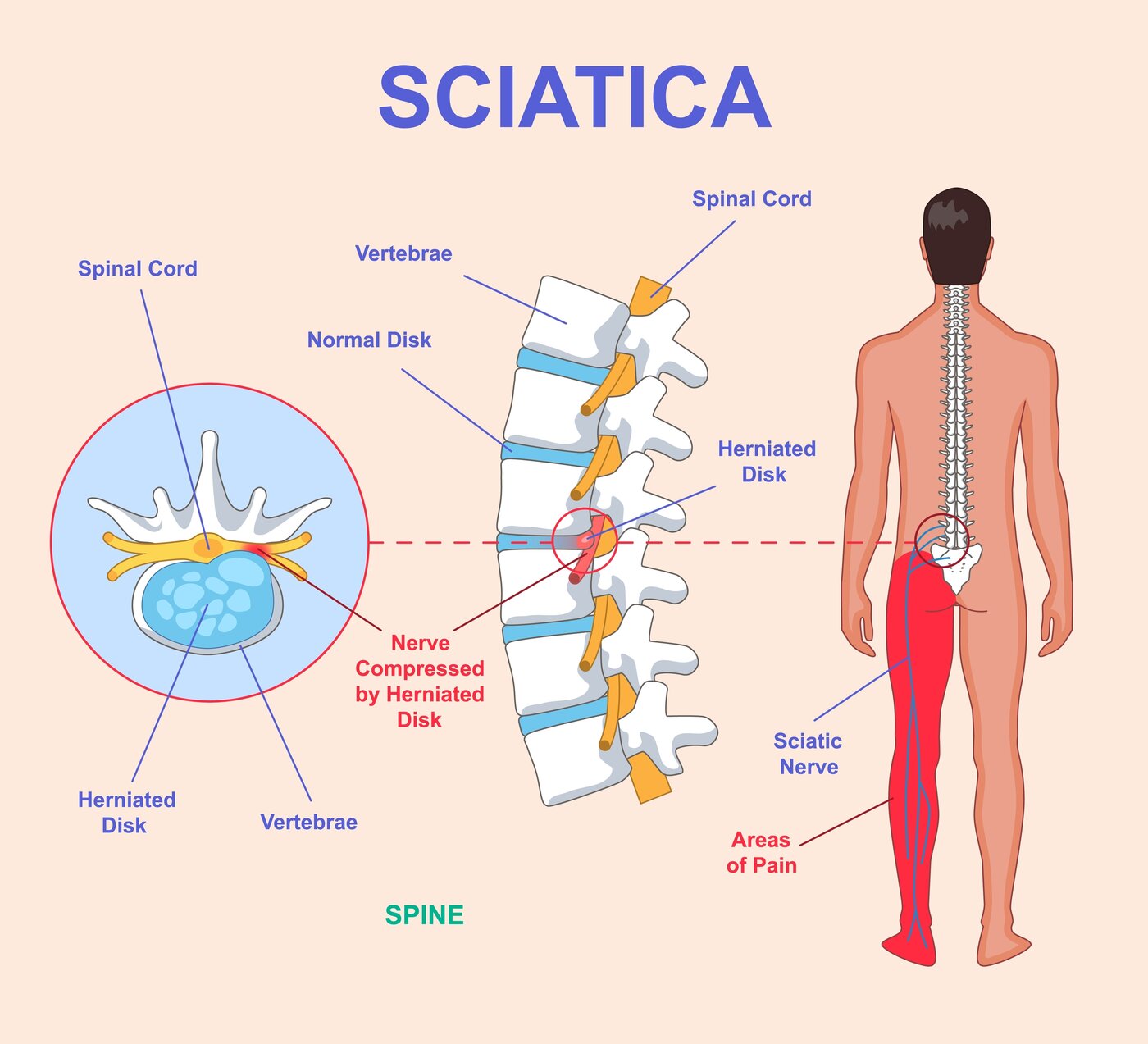
Back-related pain that may refer or radiate into the leg via the sciatic nerve. Origin can be disc, joint, or muscular, so assessment matters.
Common symptoms
- Low back pain
- Pain, numbness, or tingling into the leg
- Worse with prolonged sitting or bending
Why it happens: root cause
Spine and hip capacity vs. lifting, sitting, and training load. When load on a tissue chronically exceeds its capacity, pain shows up. My job is to close that gap, by lowering load, raising capacity, or both, so the tissue stops being overwhelmed.
A closer look
Back-related pain that may refer or radiate into the leg via the sciatic nerve. The source can be disc, joint, or muscular, so assessment matters. The good news: most cases improve without surgery when loading is managed well.
What causes it(Load > Capacity = Pain)
- Spine and hip capacity vs lifting, sitting, and training load
- Sudden load spikes
- Prolonged sitting or bending
- Deconditioning
- Sometimes a disc or joint driver
Why it keeps coming back
- Not finding and training the positions that help (directional preference)
- Not rebuilding capacity
- Returning to aggravating loads too soon
Why rest, stretching, and passive care aren't enough
Rest and passive care may calm a flare but don't build the spine and hip capacity that prevents the next one. Graded loading and movement do.
Conditions that can mimic this
- Piriformis syndrome
- Hip pathology
- Proximal hamstring tendinopathy
- SI joint irritation
Red flags, such as progressive weakness, numbness, or bowel/bladder changes, need urgent medical care. I screen for these and refer when warranted.
How I treat it
How the ADAPT Method treats your Sciatica / Low Back Pain
- A
Assess
Neurological screen and directional preference testing to identify whether disc, joint, or muscular drivers are leading, and plus a job/training history. Imaging only when red flags or persistent neuro signs warrant it.
- D
Decrease Pain
Identify positions and movements that ease symptoms (directional preference) and use them as medicine; layer Focused Shockwave (ESWT), Radial Pressure Wave (EPAT), and EMTT along the lumbar and gluteal region to calm irritated neural tissue and surrounding muscle.
- A
Activate
Restore hip and thoracic mobility, reactivate deep core and glute control, and unload the spine through better movement.
- P
Progress
Progressive loading (hinge, carry, squat) appropriate to your spine, building tolerance for sitting, lifting, and training.
- T
Transfer
Return-to-life plan, work setup, lifting strategy, running plan, so the spine handles your normal demands without flaring.
ADAPT closes the gap between LOAD and CAPACITY, lowering what's stressing the tissue while building what the tissue can handle.
FAQ
Do I need an MRI for sciatica?+
Usually not in the first 4 to 6 weeks unless I see red flags (progressive weakness, bowel/bladder changes, severe unrelenting pain). Most sciatica improves with the right movement and loading before imaging changes anything.
Should I rest in bed?+
No. Bed rest makes sciatica worse. Movement, in the directions you tolerate, is the better medicine.
Will it heal on its own?+
Many cases do, but doing nothing leaves people stuck in flare-and-recover cycles. Active care shortens episodes and reduces recurrence.
Is surgery in my future?+
Surgery is for people with progressive neurological deficits or genuine failure of well-dosed conservative care. The majority of sciatica avoids the OR.
How long until I feel better?+
Most cases feel meaningful change in 2 to 6 weeks. Full capacity rebuilds over the months after.
Will it come back?+
Recurrence drops when hip mobility, core endurance, and lifting mechanics improve. The 'maintenance' is mostly a few daily movement habits.
Do I need an MRI?+
Usually no, at least not first. Most musculoskeletal issues are diagnosed by history and exam. I use Clarius MSK diagnostic ultrasound in-office when it actually changes the plan: confirming a tendon issue, ruling between two diagnoses, or guiding treatment. I refer for MRI when red flags or surgical questions warrant it.
Is chiropractic safe for sciatica?+
Yes, and when applied to the right diagnosis. I screen carefully, choose techniques to match, and combine adjustments with loading, never as the only intervention.
Do you take insurance?+
Form & Function is a cash-based (self-pay) practice; I don't bill insurance directly. That lets me spend more time with you and build your plan around what you actually need, not what an insurer will approve. Fees are discussed up front. On request I can provide a detailed receipt (superbill) you may submit to your insurance for possible out-of-network reimbursement, though reimbursement isn't guaranteed.
What happens at the first visit?+
I sit down and talk through your history, training, and what you've already tried. Then I go through a hands-on movement and strength assessment, look at the painful area (and the joints above and below), and use Clarius MSK ultrasound in-office when it sharpens the diagnosis. You leave with a working diagnosis and a written plan, not a vague 'come back next week.'
Book your evaluation.
An honest assessment is the first step in the ADAPT method, and the fastest path to a real plan.