
Shin Splints (Medial Tibial Stress Syndrome)
Diffuse pain along the inner shin, common in runners ramping up volume.
What it is
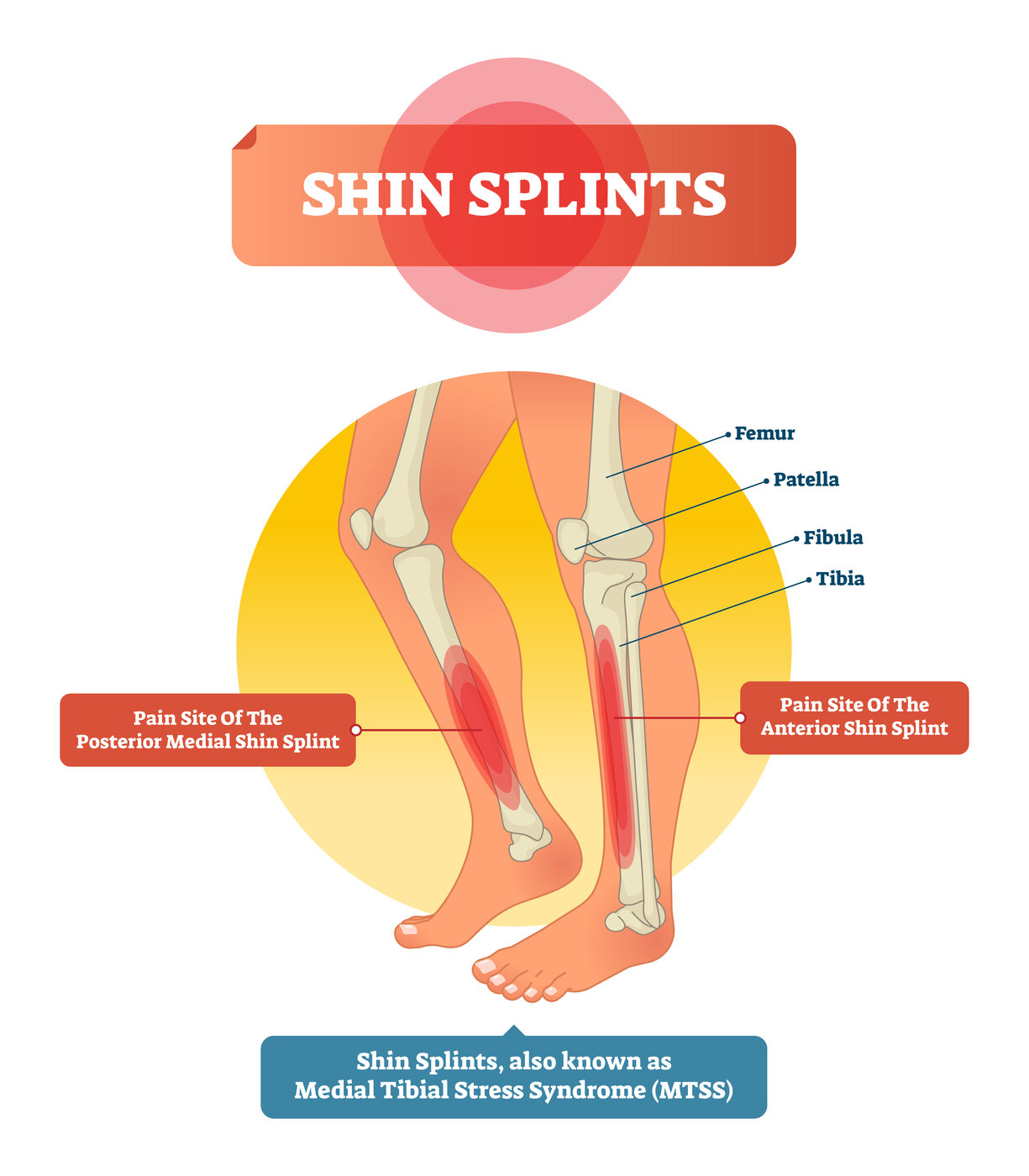
Bone and connective-tissue stress along the medial tibia from repetitive impact loading that's outpaced the body's adaptation.
Common symptoms
- Aching along the inner edge of the shin
- Worse early in runs, may settle, returns afterward
- Tender to touch along the bone
Why it happens: root cause
Too much volume, too much impact, too fast, often paired with a gait pattern that loads the tibia heavily. When load on a tissue chronically exceeds its capacity, pain shows up. My job is to close that gap, by lowering load, raising capacity, or both, so the tissue stops being overwhelmed.
A closer look
'Shin splints' is a catch-all for pain along the tibia from repetitive impact. The most common diagnosis is Medial Tibial Stress Syndrome (MTSS), which can involve periosteal irritation, fascial/muscular traction stress, or an early bone stress reaction. Shin pain lives on a spectrum: irritation → bone stress reaction → stress fracture. Running through it is like driving on a warning light. Clarius MSK ultrasound helps me tell whether your shin pain is consistent with MTSS or a more focal bone stress injury.
What causes it(Load > Capacity = Pain)
- Sudden increases in mileage
- Hill running and hard surfaces
- Footwear changes
- Reduced calf strength
- Foot mechanics and limited ankle mobility
- Rapid training progression
Why it keeps coming back
- Returning to impact before load tolerance is restored
- Unaddressed calf/foot strength deficits
- Mobility limitations
- Training errors (volume, surface, pace)
Why rest, stretching, and passive care aren't enough
Temporary load reduction can settle early irritation, but long-term recovery depends on restoring strength, impact tolerance, and movement efficiency; rest alone leaves the same warning light on.
Conditions that can mimic this
- Bone stress injury / stress fracture
- Posterior tibial tendon dysfunction
- Chronic exertional compartment syndrome
- Tibial bone stress reaction
If pain is focal (one small spot), worse with hopping, increasing week to week, or present at rest/at night, it may be a bone stress injury rather than classic shin splints, imaging (MRI) may be warranted.
How I treat it
How the ADAPT Method treats your Shin Splints (Medial Tibial Stress Syndrome)
- A
Assess
Differentiate medial tibial stress syndrome from a bone stress injury (focal pinpoint pain, hop test, training history). If pain is focal and worsening, I slow down and refer for imaging when appropriate.
- D
Decrease Pain
Cut impact volume and soften surfaces short-term, then apply Focused Shockwave (ESWT), Radial Pressure Wave (EPAT), and EMTT along the medial tibial border and surrounding soft tissue to calm the bony reaction and accelerate remodeling.
- A
Activate
Restore calf, soleus, and tibialis posterior strength along with hip control so the tibia isn't the only thing absorbing impact.
- P
Progress
Progressive tibialis loading, calf raises, and gradual return to impact, watching the 'next-morning' response as my dose meter.
- T
Transfer
Structured return-to-run with mileage caps and cadence cues from Running Analysis, so the same training mistake doesn't repeat.
ADAPT closes the gap between LOAD and CAPACITY, lowering what's stressing the tissue while building what the tissue can handle.
FAQ
Are shin splints the same as a stress fracture?+
No, but they live on the same spectrum. Shin splints are diffuse pain along the inner tibial border; a stress fracture is focal, pinpoint pain that worsens with impact. If I suspect a stress injury, I change the plan and may image.
What causes shin splints?+
Almost always too much, too fast: a mileage jump, new pace work, or harder surfaces before the calf-tibia complex could adapt. Gait patterns that overload the tibia magnify it.
Do I need to stop running?+
Usually I modify, and drop mileage, add walk breaks, soften surfaces, rather than fully stop. Full rest doesn't build the capacity the tibia is missing.
Do I need an MRI?+
Usually no, at least not first. Most musculoskeletal issues are diagnosed by history and exam. I use Clarius MSK diagnostic ultrasound in-office when it actually changes the plan: confirming a tendon issue, ruling between two diagnoses, or guiding treatment. I refer for MRI when red flags or surgical questions warrant it.
Does shockwave help shin splints?+
Yes. Focused Shockwave is well tolerated along the medial tibia and helps calm the bony reaction while you rebuild loading capacity.
How long until I can train normally?+
Most uncomplicated cases settle in 4 to 8 weeks with a real loading and mileage plan. Recurrent cases benefit most from Running Analysis to fix the input.
Will it come back?+
Only if mileage jumps outpace tissue adaptation again. The classic 10% rule isn't magic, but the principle holds: progress load slowly, and keep tibialis and calf strength in the rotation year-round.
Do you take insurance?+
Form & Function is a cash-based (self-pay) practice; I don't bill insurance directly. That lets me spend more time with you and build your plan around what you actually need, not what an insurer will approve. Fees are discussed up front. On request I can provide a detailed receipt (superbill) you may submit to your insurance for possible out-of-network reimbursement, though reimbursement isn't guaranteed.
What happens at the first visit?+
I sit down and talk through your history, training, and what you've already tried. Then I go through a hands-on movement and strength assessment, look at the painful area (and the joints above and below), and use Clarius MSK ultrasound in-office when it sharpens the diagnosis. You leave with a working diagnosis and a written plan, not a vague 'come back next week.'
Book your evaluation.
An honest assessment is the first step in the ADAPT method, and the fastest path to a real plan.