
Plantar Fasciitis / Heel Spur
Stabbing heel pain, usually worst with the first steps in the morning.
What it is
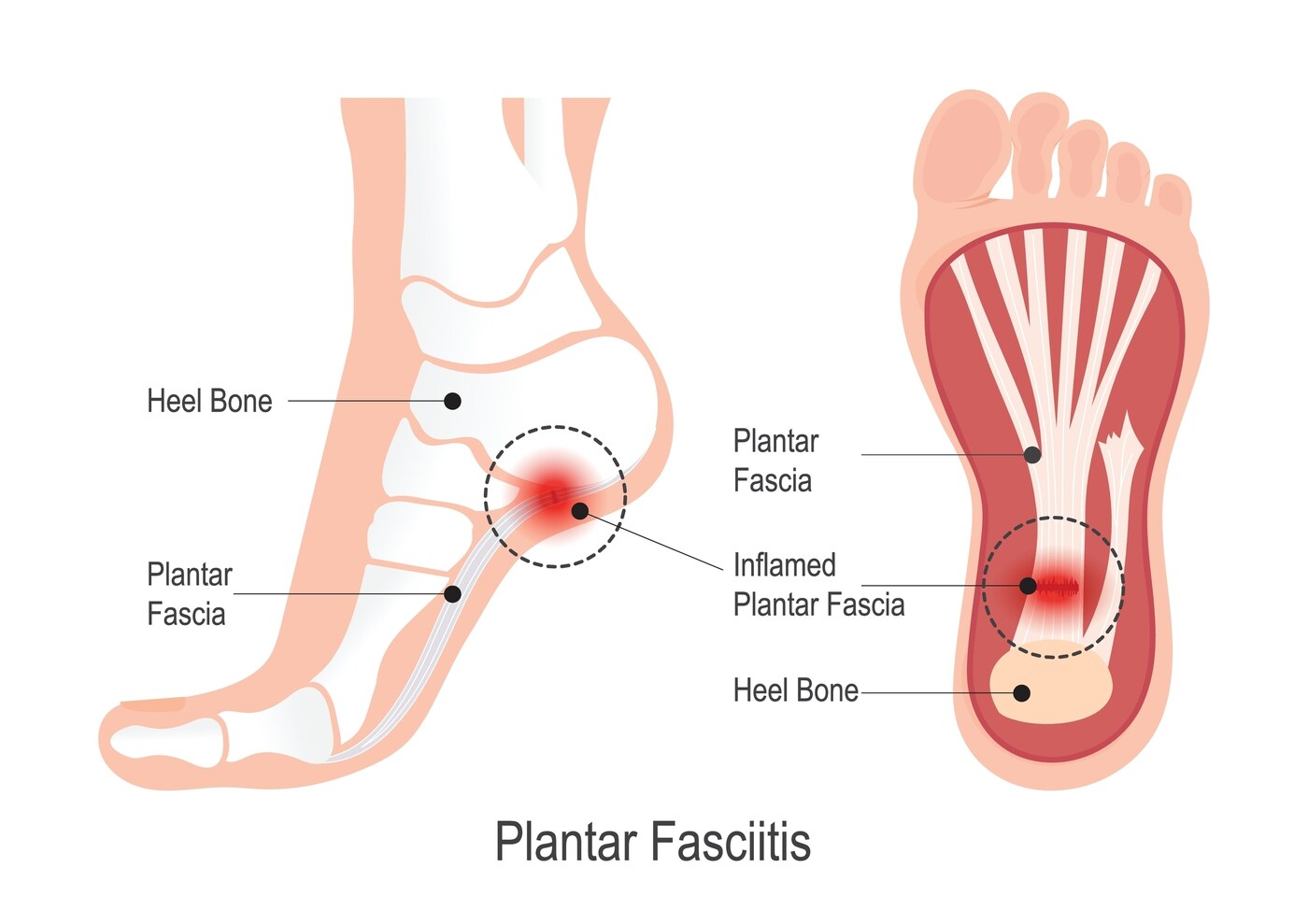
Irritation and degeneration of the plantar fascia, the thick band of tissue along the bottom of the foot. Often associated with a heel spur, but the spur isn't usually the pain source.
Common symptoms
- Sharp pain at the inside of the heel
- Worst with first steps in the morning or after sitting
- Tight calves, stiff ankle
- Pain eases with movement but returns after rest
Why it happens: root cause
Calf/foot capacity hasn't kept up with training load, footwear changes, or standing demands. When load on a tissue chronically exceeds its capacity, pain shows up. My job is to close that gap, by lowering load, raising capacity, or both, so the tissue stops being overwhelmed.
What causes it(Load > Capacity = Pain)
- Sudden increase in running or walking volume
- Prolonged standing or walking on hard surfaces
- Limited ankle mobility
- Calf tightness and weakness
- Poor foot strength and control
- Improper footwear or load distribution
Why it keeps coming back
- Symptoms improve before the tissue is fully recovered
- Relying only on rest or stretching without restoring foot and calf strength
- Poor load progression
- Returning to activity too quickly
- If tissue capacity isn't rebuilt, the same stress reproduces symptoms
Why rest, stretching, and passive care aren't enough
Rest, stretching, and orthotics may relieve symptoms temporarily but don't restore tissue capacity, strength, or load tolerance, which is why symptoms come back as soon as you ramp activity again.
Conditions that can mimic this
- Calcaneal stress reaction / stress fracture
- Heel fat pad irritation
- Achilles tendon overload
- Baxter's nerve irritation
- Posterior tibial tendon dysfunction
When clinically indicated, Clarius MSK ultrasound can evaluate the plantar fascia and surrounding tissue in real time to confirm the diagnosis.
How I treat it
How the ADAPT Method treats your Plantar Fasciitis / Heel Spur
- A
Assess
Hands-on exam of the heel, arch, calf, and big-toe extension, plus a look at your footwear, training jumps, and standing demands. Clarius MSK ultrasound is used when I want to confirm fascia thickening or rule out a partial tear.
- D
Decrease Pain
Short-term load modification (mileage, standing time, footwear), then layer Focused Shockwave (ESWT), Radial Pressure Wave (EPAT), and EMTT around the heel and plantar fascia to calm irritated tissue and kick-start remodeling, laser therapy (photobiomodulation) can be added for reactive flares.
- A
Activate
Restore calf length, big-toe extension, and intrinsic foot control with FRC-style mobility and isolation drills.
- P
Progress
Progressive heel-raise loading (straight-knee and bent-knee), tibialis work, and graded standing/walking volume to rebuild fascia and calf capacity.
- T
Transfer
Return-to-run plan with cadence/form cues from Running Analysis, plus simple daily maintenance so morning pain doesn't sneak back in.
ADAPT closes the gap between LOAD and CAPACITY, lowering what's stressing the tissue while building what the tissue can handle.
FAQ
What actually causes plantar fasciitis?+
It's almost always a capacity problem, not a structural one. The fascia and calf complex couldn't keep up with a change in load; new shoes, more mileage, a new job on your feet, or a long break followed by a fast ramp. The heel spur seen on X-ray is usually an effect, not the cause of pain.
How long does plantar fasciitis take to heal?+
Most cases meaningfully improve in 4 to 8 weeks of focused care, with full tissue remodeling continuing for months. People who have been dealing with it for a year often respond faster than they expect once shockwave plus progressive loading is in place.
Should I stop running?+
Usually no. I modify load, dropping mileage, easing pace, smarter surfaces, and rather than fully shutting you down. Complete rest tends to feel good for a week and then the first run hurts just as much, because the tissue's capacity is still low.
Do I need an MRI?+
Usually no, at least not first. Most musculoskeletal issues are diagnosed by history and exam. I use Clarius MSK diagnostic ultrasound in-office when it actually changes the plan: confirming a tendon issue, ruling between two diagnoses, or guiding treatment. I refer for MRI when red flags or surgical questions warrant it.
Does shockwave actually work for plantar fasciitis?+
Yes. Focused Shockwave (ESWT) has strong evidence for chronic plantar fasciitis, especially when paired with a loading program. It's typically a series of 3 to 5 weekly sessions.
How is this different from a cortisone shot?+
A cortisone shot can mute pain for a few weeks but doesn't change tissue capacity, and repeat injections into the plantar fascia carry a real risk of fascia rupture and fat-pad atrophy. Shockwave plus loading builds the tissue rather than numbing it.
Will it come back?+
Not if I close the gap between load and capacity. Most recurrences happen when people stop loading the calf and foot once pain is gone, I leave you with a maintenance plan so the fascia stays ahead of your training.
Is plantar fasciitis the same as a heel spur?+
No. A heel spur is a bone finding on X-ray; plantar fasciitis is irritation of the fascia. Plenty of people have heel spurs and zero pain, and plenty of painful heels have no spur. I treat the fascia and the load, not the picture.
Do you take insurance?+
Form & Function is a cash-based (self-pay) practice; I don't bill insurance directly. That lets me spend more time with you and build your plan around what you actually need, not what an insurer will approve. Fees are discussed up front. On request I can provide a detailed receipt (superbill) you may submit to your insurance for possible out-of-network reimbursement, though reimbursement isn't guaranteed.
What happens at the first visit?+
I sit down and talk through your history, training, and what you've already tried. Then I go through a hands-on movement and strength assessment, look at the painful area (and the joints above and below), and use Clarius MSK ultrasound in-office when it sharpens the diagnosis. You leave with a working diagnosis and a written plan, not a vague 'come back next week.'
Book your evaluation.
An honest assessment is the first step in the ADAPT method, and the fastest path to a real plan.