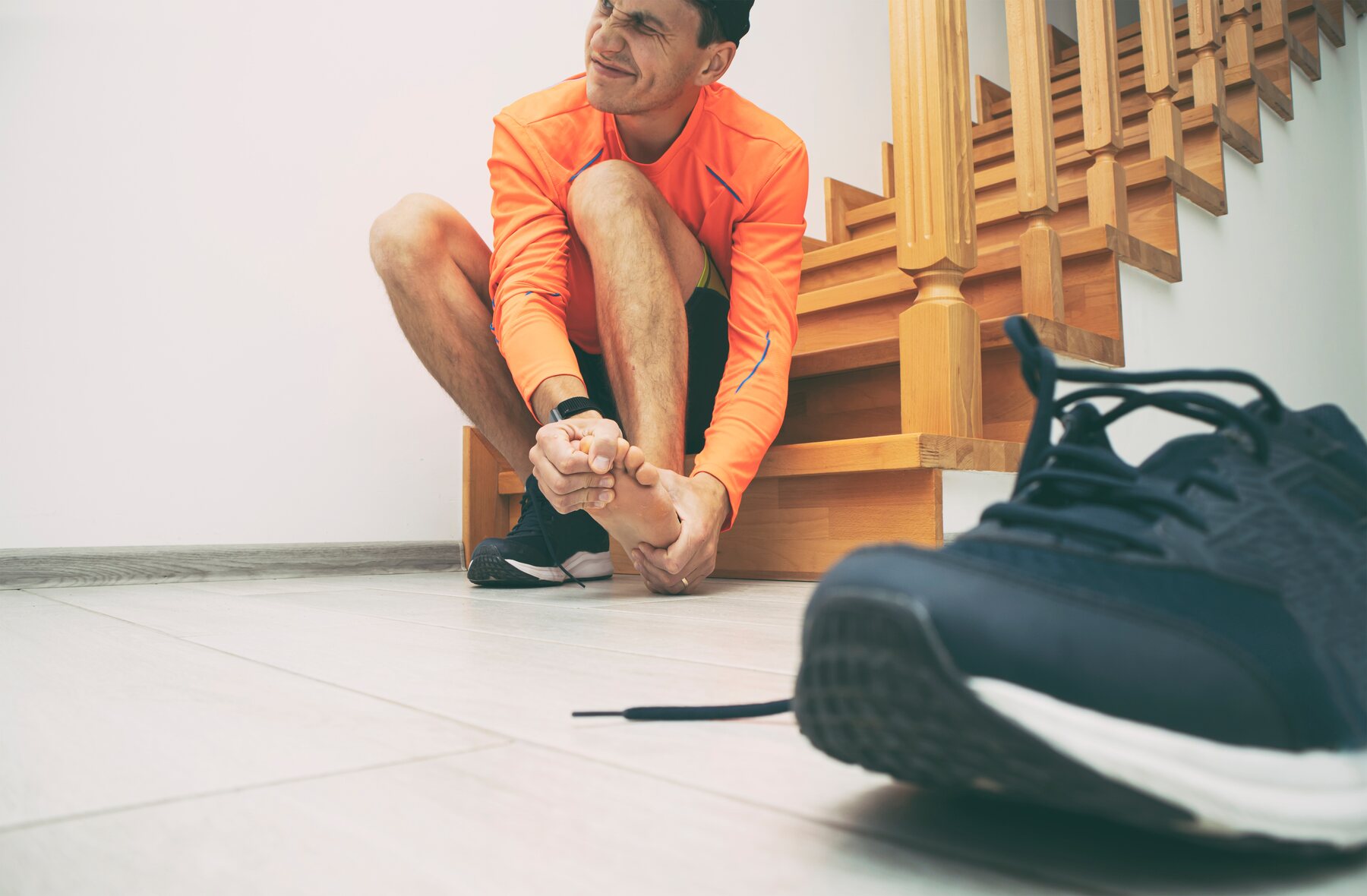
Heel pain does not automatically mean stop running. How to tell plantar fasciitis apart from the injuries that mimic it, the rules for when running is safe, and what actually rebuilds the tissue.
Most runners with plantar fasciitis can keep running in a modified form. Rest lowers load but never raises capacity, which is why pain returns at the same mileage. Rule out a calcaneal bone stress injury first, then run by the pain rules below while progressive calf and foot loading rebuilds the tissue. Focused shockwave, radial pressure wave (EPAT), EMTT, and BioFlex laser speed up the runway, they do not replace the loading program.
Almost every runner who walks into my office with heel pain has already been told the same thing. Rest it. Stop running. Come back when it stops hurting.
I understand why that advice gets handed out. It is also, most of the time, the wrong answer. Rest lowers the load on the tissue, which quiets the pain, but it does nothing to raise the tissue's capacity. So you come back at the same mileage you left, and the heel greets you at mile two like nothing happened.
Load greater than capacity equals pain. You close that gap by lowering the load, raising the capacity, or both. Only one of those requires you to stop running.
First, make sure it is actually plantar fasciitis
The name is a little misleading. What we are usually looking at is not raw inflammation but degenerative change in the plantar fascia, the thick band running from your heel to the ball of your foot. The classic presentation is sharp pain at the inside of the heel, worst with the first few steps in the morning or after sitting, easing once you get moving, then returning later in the day. You can read the full condition breakdown on my plantar fasciitis treatment page.
Several other things wear that costume, and they are not managed the same way:
- Calcaneal bone stress injury. Pinpoint heel pain, hurts to walk, hurts to hop, does not warm up. This one needs load removed, not loaded through. See bone stress injury.
- Insertional Achilles tendinopathy. Pain at the back of the heel rather than the underside. See Achilles tendon treatment.
- Fat pad irritation. More central and bruise-like, often after a shoe change or a hard track session.
- Baxter's nerve entrapment or tarsal tunnel. Burning, tingling, or numbness rather than a sharp mechanical stab.
Sorting this out is a hands-on exam, a history of your training load, and a look at how you actually move. When two of those diagnoses are genuinely competing, or when I want to see the fascia's thickness before deciding on a treatment dose, I will put the Clarius MSK ultrasound on it for a few minutes. It is a differentiator and a targeting tool, not something I run on every visit. More on diagnostic ultrasound.
The rules for running through it
Once a bone stress injury is ruled out, most runners with plantar fasciitis can keep running in some form. Here is the test I give them.
/You can keep running if
- Pain stays at or below 3 out of 10 during the run
- It does not climb as the run goes on
- Walking is comfortable
- Your morning stiffness the next day is no worse than the day before
That last one is the real referee. Morning symptoms are your honest report card.
/You should not run if
- Walking hurts
- Hopping on that foot produces sharp pain
- Symptoms are worse week over week
- The heel aches at rest
Running through it does not mean running the same week you were running. It usually means less volume, less speed, flatter ground, and a temporary end to barefoot or minimal-shoe work while we rebuild.
What actually fixes it
/Capacity
Progressive calf and foot loading is the foundation. Bent-knee and straight-knee calf raises, loaded toe flexion, and eventually single-leg work under real weight. This is the part nobody wants to hear and the part that keeps it from coming back.
/Range and control
Restricted ankle dorsiflexion and a stiff big toe force the fascia to absorb what the joints above it should be sharing. That is functional range conditioning work.
/Mechanics
Cadence, footstrike, and how long you spend on the ground change heel load meaningfully. A running assessment tells us whether your gait is part of the problem instead of guessing.
/Tissue-level treatment
For stubborn cases, this is where the regenerative tools earn their place: focused shockwave into the fascia's insertion, radial pressure wave, also called EPAT across the calf and arch, EMTT for deeper tissue recovery, and Meditech BioFlex laser, or photobiomodulation when the tissue needs help calming down. Plantar fasciitis is one of the best-supported indications for focused shockwave in the literature. It works by restarting stalled healing, which means it builds over a series of weekly visits rather than switching the pain off in one.
None of those replace the loading program. They make the loading program tolerable sooner.
Book your evaluation
If your heel has been arguing with you for more than a few weeks, get it looked at properly before you lose a training block to it. Book your evaluation and we will find out what is actually driving it, then build the plan that keeps you running.
Frequently Asked Questions
Can I run with plantar fasciitis?
Usually yes, in a modified form, as long as a bone stress injury has been ruled out. Keep pain at or below 3 out of 10 during the run, make sure it does not climb as you go, and check that your morning stiffness the next day is no worse than the day before.
How long does plantar fasciitis take to resolve?
It depends on how long it has been going on and how much capacity the tissue has lost. Cases caught early often turn around in a few weeks. Long-standing cases usually need a few months of progressive loading, with regenerative treatment shortening the timeline.
Does shockwave therapy work for plantar fasciitis?
Plantar fasciitis is one of the best-supported indications for focused shockwave therapy. It stimulates a stalled healing response, so results build over a series of weekly sessions rather than appearing after one visit. It works best paired with a progressive loading program.
Is a heel spur causing my pain?
Usually not. Heel spurs are common in people with no heel pain at all, and plenty of painful heels have no spur. The pain almost always comes from the fascia and the load going through it, not the spur itself.
Related conditions & treatments
Not sure what you're dealing with?
A thorough evaluation tells me exactly where the load-capacity gap is and what it takes to close it.